What Is Short Selling?
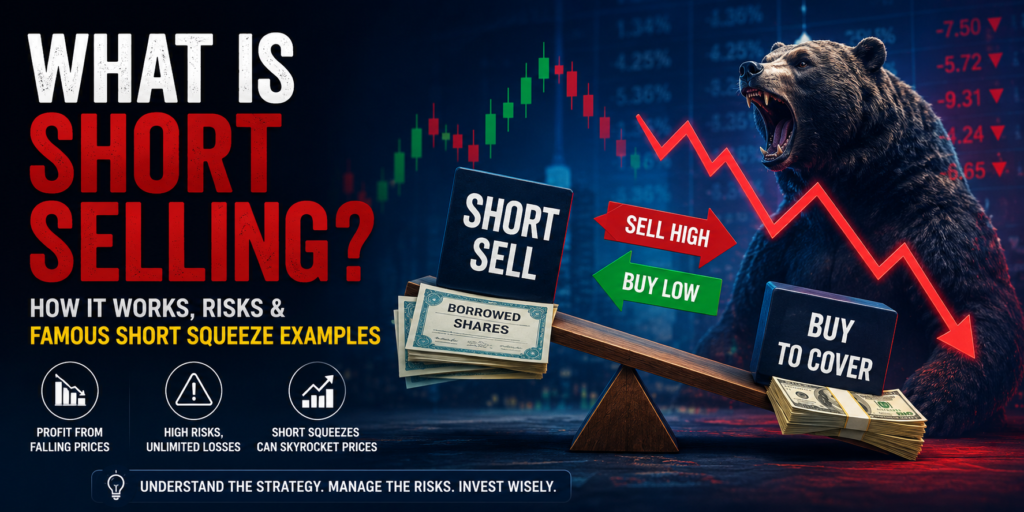
Short selling explained in simple terms means trying to profit when you believe the price of a stock will fall instead of rise. In a traditional investment, an investor buys shares first and hopes to sell them later at a higher price. Short selling turns that idea around: the investor typically borrows shares, sells them, and later attempts to buy equivalent shares back at a lower price. If the price falls as expected, the difference between the selling price and the repurchase price can represent a profit, after applicable costs and fees. The U.S. Securities and Exchange Commission explains that short selling can also be used for purposes beyond speculation, including hedging and providing liquidity in the market.
Think of it like making a prediction that a particular item will become cheaper in the future. Imagine a stock is trading at $60, and an investor expects it to decline. The investor borrows a share and sells it for $60, then waits to see what happens. If the stock later falls to $40, the investor could buy a replacement share for $40 and return it to the lender, creating a theoretical $20-per-share difference before borrowing expenses, commissions, and other costs. However, if the stock rises to $80 instead, the investor would need to spend $80 to replace a share originally sold for $60, producing a $20-per-share loss before costs. This is the basic concept behind short selling explained: the investor wants to sell high first and buy low later, but the market may move in the opposite direction.
Short Selling Explained With a Simple Example
To understand the concept more clearly, imagine an investor believes Company ABC is overvalued and that its stock price may decline. The investor borrows 100 shares when the market price is $50 per share and sells those borrowed shares for $5,000. Later, the stock falls to $35 per share, so the investor buys 100 shares for $3,500 and uses them to return the borrowed shares. The difference is $1,500 before interest, stock-borrowing charges, commissions, taxes, and other expenses. The important point is that the investor did not originally own the shares being sold; the shares were borrowed and eventually had to be returned.
Now imagine the opposite outcome. Instead of falling to $35, the stock rises to $75. The investor still needs to buy 100 shares to close the position, but now those shares cost $7,500. The investor sold the borrowed shares for $5,000 and has to spend $7,500 to replace them, resulting in a $2,500 loss before additional costs. This is where short selling becomes fundamentally different from simply buying a stock. When someone purchases a stock, the amount invested generally represents the maximum direct loss if the company becomes worthless, while a short position theoretically has no fixed maximum loss because a stock’s price can continue rising.
How Does Short Selling Work?
The mechanics of short selling can initially seem backward, but the basic process is relatively straightforward. A short seller generally works through a brokerage firm that facilitates the borrowing of shares. The investor sells those borrowed shares in the market, hoping the stock price will decline. At some later point, the investor buys equivalent shares in the market and returns them to the lender, effectively closing the short position. The brokerage firm may charge borrowing-related costs or interest, and the investor can also have additional obligations depending on the security and account arrangements.
The entire process can be thought of as a financial “round trip.” The first part involves borrowing and selling the stock, while the second part involves buying it back and returning it. If the repurchase price is lower than the original selling price, the short seller may profit from the difference. If the repurchase price is higher, the short seller loses money. The challenge is that the investor has to eventually close the position, meaning a temporary increase in the stock price can create pressure even if the investor still believes the company is overvalued in the long run. This is one reason short selling requires careful risk management and is generally considered a strategy for experienced market participants.
The Step-by-Step Short Selling Process
A simplified short-selling transaction generally follows this sequence:
- The investor identifies a stock they believe may decline in price.
- The brokerage facilitates borrowing shares, subject to availability and applicable rules.
- The investor sells the borrowed shares in the open market.
- The stock price changes as the market responds to company news, economic conditions, investor sentiment, and other factors.
- The investor buys equivalent shares to close the short position.
- The borrowed shares are returned to the lender, with the investor’s profit or loss determined by the price difference and applicable costs.
The critical detail is that the short seller eventually needs to buy shares to close the position. That requirement becomes especially important during a short squeeze. If many short sellers simultaneously decide or are forced to close their positions while demand for the stock is already high, their buying can add further upward pressure to the price. This creates a situation where a strategy designed to profit from falling prices can contribute to a rapid rise instead.
Borrowing and Selling Shares
When shares are borrowed for a short sale, the investor does not simply receive free stock. The brokerage arrangement involves obligations and potential costs. According to Investor.gov, borrowed shares may come from a brokerage firm’s inventory, another customer’s margin account, or another lender. The short seller may also be responsible for certain payments connected with the borrowed stock, such as compensating the lender for dividends paid while the shares are on loan.
This borrowing element is important because it means short selling is not simply “selling a stock you don’t like.” There is an actual process behind the transaction, and the investor has to manage the position until it is closed. Availability of shares to borrow, borrowing costs, margin requirements, and changes in market conditions can all affect the outcome. A stock that appears attractive to short sellers can become increasingly expensive or difficult to short if demand for borrowed shares rises or the stock price moves sharply higher.
Why Do Investors Short Sell Stocks?
There are several reasons why market participants may use short selling. The most obvious is speculation: an investor believes a stock is overpriced and expects its price to decline. If that prediction is correct, the short seller may potentially profit from the downward move. However, short selling is not limited to bearish speculation. The SEC notes that short selling can also serve legitimate market functions, including hedging certain risks and providing liquidity when unexpected demand occurs.
For example, an investor or institution may have exposure to a company or industry and use a short position as part of a broader hedging strategy. Professional investors may also analyze financial statements, business models, competitive threats, and valuation metrics to identify companies they believe are vulnerable to declining prices. In some cases, short sellers conduct detailed research that uncovers weaknesses the wider market may have overlooked. Their activity can contribute to price discovery by expressing a negative view that challenges overly optimistic assumptions. Of course, being bearish does not automatically mean being correct, and short sellers can face substantial losses when market sentiment changes unexpectedly.
Short selling can therefore play a complicated role in financial markets. Critics may argue that aggressive short selling puts pressure on companies or can contribute to market declines, while supporters point out that short sellers can identify problems, challenge excessive valuations, and add liquidity. The legality of short selling itself is well established in the United States, although manipulative or abusive practices are prohibited. The SEC’s Regulation SHO framework addresses aspects of short selling and related market practices.
What Is a Short Squeeze?
A short squeeze happens when a heavily shorted stock rises sharply and short sellers rush to buy shares to close their positions. This buying can increase demand for the stock, potentially pushing the price even higher. The resulting price increase can create additional pressure on other short sellers, particularly those facing margin requirements or trying to limit losses. In this way, a short squeeze can become something of a feedback loop: rising prices pressure short sellers, short sellers buy to close positions, and that buying can contribute to further price increases.
The key ingredient is usually an imbalance between a large number of bearish positions and a sudden increase in buying interest. That buying pressure might come from positive company news, unexpected earnings, retail investor enthusiasm, institutional activity, options-related trading, or a combination of factors. A short squeeze does not necessarily happen simply because a stock has high short interest. There must generally be enough upward price pressure and sufficient difficulty for short sellers to remain in their positions. The more crowded the bearish trade, the more vulnerable it can potentially become if the market suddenly moves in the opposite direction.
How a Short Squeeze Happens
Imagine that many investors have shorted a company’s stock because they expect its price to fall. Suddenly, the company announces unexpectedly positive news, and the stock begins rising quickly. Some short sellers decide to exit before their losses become larger, so they buy shares to close their positions. That additional buying increases demand, which may push the stock price higher and encourage even more short sellers to cover. The cycle can continue as long as buying pressure remains strong and available shares become harder to obtain at reasonable prices.
This dynamic is why short squeezes can produce dramatic market movements. The SEC’s analysis of the 2021 GameStop episode noted that short interest had reached levels above 100% of shares outstanding, a situation that can occur because shares may be lent multiple times through successive transactions. The report also observed that such exceptionally high short interest was unusual compared with typical levels, helping explain why GameStop became such a striking case study in market structure and short selling.
The Biggest Risks of Short Selling
Short selling carries risks that are different from those associated with simply buying and holding a stock. The most obvious concern is that a stock can rise much more than an investor expects. A company that looks overvalued at $50 could rise to $100, $200, or potentially higher. Because there is theoretically no ceiling on a stock’s price, the potential loss on a short position is not capped in the same way as the potential loss from buying a stock outright. The SEC specifically warns that short selling can expose investors to theoretically unlimited losses.
There are also costs associated with maintaining a short position. Depending on the brokerage arrangement, investors may face borrowing fees, interest, margin requirements, and other charges. If the borrowed stock pays a dividend, the short seller may have to compensate the lender for that payment. These expenses can gradually reduce returns even when the stock eventually moves in the anticipated direction.
Unlimited Loss Potential
The concept of unlimited loss potential is perhaps the most important risk to understand. Suppose an investor buys 100 shares at $50 per share. The initial investment is $5,000, and if the stock eventually falls to zero, the direct loss is $5,000. With a short position, the mathematical situation is different. If an investor shorts 100 shares at $50 and the stock rises to $100, the loss is $5,000; if it rises to $200, the loss becomes $15,000; and if it continues rising, the potential loss continues to increase.
That does not mean every short position will result in an unlimited loss in practice. Investors may close positions earlier, use risk controls, or have brokerage requirements that force positions to be reduced. However, the underlying mathematical risk remains. This is one of the reasons regulators and investor education resources emphasize that short selling is generally a strategy for experienced investors who understand margin and the risks involved.
Margin Calls and Borrowing Costs
Short selling commonly involves margin arrangements, which can create additional financial pressure. If a shorted stock rises significantly, a brokerage may require additional funds or collateral to maintain the position. An investor who cannot meet the applicable requirements may have the position closed, potentially at an unfavorable price. During a fast-moving short squeeze, this can make the situation even more difficult because prices may change rapidly while many investors are attempting to exit at the same time.
Borrowing costs can also change. A stock that is easy to borrow at one point may become more expensive to borrow when demand for short positions increases and available shares become limited. These costs may reduce the potential profit of a successful short trade or increase the expense of holding a position while waiting for the anticipated decline. For anyone learning about short selling, it is essential to understand that the price movement is only one part of the equation; financing, borrowing, margin, and transaction costs can all affect the final result.
Famous Short Squeeze Examples
Short squeezes have appeared throughout financial-market history, but two examples are particularly well known: the Volkswagen episode of 2008 and the GameStop phenomenon of 2021. These events were very different in their causes and market structures, yet both demonstrated how a crowded short position can become vulnerable when the available supply of shares does not easily meet sudden demand. They also showed why short sellers must consider not only whether a company is overvalued but also how crowded the trade has become.
GameStop Short Squeeze
The GameStop short squeeze became one of the most famous market events of the modern era. In early 2021, individual investors became highly active in certain heavily shorted stocks, with GameStop becoming the most prominent example. Online communities and retail investors focused attention on the company’s substantial short interest, and a rapid increase in buying activity helped drive the stock dramatically higher. Reuters reported that GameStop’s stock rose by more than 1,600% during the surge, creating enormous losses for some short sellers who were forced to buy shares at much higher prices to close their positions.
The SEC’s subsequent staff report provided additional insight into the unusual structure of the event. It found that GameStop’s short interest had reached 109.26% of shares outstanding on December 31, 2020, and explained that short interest can exceed 100% when shares are lent multiple times through successive transactions. The episode became a major discussion point about retail trading, options activity, market structure, social media, and the risks of crowded short positions.
The GameStop episode also demonstrated an important lesson: markets are influenced by more than traditional valuation models in the short term. Investor sentiment, momentum, trading activity, expectations, and positioning can all play significant roles. A short seller may believe that a company’s fundamentals justify a lower price, but if a powerful wave of buying arrives before that thesis plays out, the short position can become extremely costly. The event remains one of the clearest modern examples of how a heavily shorted stock can experience extraordinary volatility.
Volkswagen Short Squeeze
The Volkswagen short squeeze of 2008 is another famous example, although its circumstances were very different from GameStop. During a period of intense market uncertainty, Porsche disclosed that it had built a significant economic exposure to Volkswagen while also holding options that could increase its effective control over Volkswagen shares. The resulting situation left relatively few shares available for trading compared with the number of investors who had bearish positions. As demand for shares surged, Volkswagen’s stock price experienced an extraordinary move, briefly making the company one of the world’s most valuable companies by market capitalization.
The Volkswagen episode illustrates a critical concept in short selling: share availability matters. A stock may have significant short interest, but the real vulnerability of short sellers depends on how many shares are actually available for trading and how quickly those shares can be acquired. If the supply of freely available shares becomes unusually tight while short sellers are trying to exit, the price can move dramatically. This is why short interest should never be viewed as a guarantee that a short squeeze will occur; market structure, liquidity, ownership concentration, and buying pressure all matter.
The two examples offer contrasting lessons. GameStop highlighted the power of coordinated attention, retail participation, and extreme short interest in a highly active modern market. Volkswagen demonstrated how ownership structures and limited share availability can create extraordinary pressure on short sellers. Both cases show that short selling is not merely a bet on whether a stock is “too expensive.” It is also a bet on timing, liquidity, market psychology, and the ability to remain solvent while waiting for the market to agree with the thesis.
Short Selling vs. Buying Stocks
The easiest way to understand short selling is to compare it with a conventional long investment. When an investor buys a stock, they generally expect the price to increase over time. Their potential gain is theoretically unlimited because a stock can continue rising, while their direct loss is generally limited to the amount invested if the stock falls to zero. Short selling reverses the desired direction: the investor wants the stock price to decline, but the potential loss can theoretically continue increasing as the price rises.Is Short Selling Legal and Regulated?
Short selling is legal in the United States, but it operates within a regulatory framework designed to address abusive practices and market integrity. The SEC states that most short sales are legal, while manipulative short-selling activity is prohibited. For example, transactions intended to artificially depress a security’s price or create misleading market activity can violate securities laws. Regulation SHO provides rules and requirements relating to short sales, including areas involving locate requirements and failures to deliver.
It is also important to distinguish legitimate short selling from misleading or manipulative behavior. A person expressing a negative opinion about a company or taking a short position is not automatically engaging in illegal activity. Markets depend on investors being able to express both positive and negative views. The problem arises when someone attempts to manipulate prices through deceptive transactions or false information.
For individual investors, the practical lesson is simple: understanding the legal framework does not eliminate the financial risks. Even when a short position is completely legitimate, it can still lose money quickly if the market moves unexpectedly. Anyone researching the subject should therefore separate two questions: Is the strategy legally permitted? and Is the strategy financially appropriate for the investor? Those are very different questions.
Key Lessons From Short Selling and Short Squeezes
Short selling offers several important lessons about how financial markets work. First, a correct long-term thesis does not guarantee a profitable trade. An investor might correctly believe that a company faces serious challenges but still lose money by shorting the stock if the price rises sharply before eventually declining. The timing of a trade can matter just as much as the underlying analysis.
Second, crowded trades can become dangerous. When many investors take the same position, the trade may appear attractive because the consensus seems strong. However, if circumstances suddenly change, everyone may try to exit simultaneously. In a short squeeze, this dynamic can become particularly intense because short sellers are buyers when they close their positions, potentially adding fuel to an upward price movement.
Third, short interest is useful information but should not be treated as a prediction machine. High short interest can indicate that many investors are bearish, but it does not guarantee a squeeze. A stock can remain heavily shorted for a long time without experiencing a dramatic rally, while a squeeze generally requires a combination of rising prices, buying pressure, limited liquidity, and pressure on short sellers.
Finally, the most famous short squeezes remind investors that market prices are influenced by human behavior. Fear, optimism, urgency, social attention, and momentum can all affect decisions. The GameStop episode demonstrated how rapidly sentiment can change when large groups of investors focus on the same stock, while the Volkswagen case showed how unusual share availability can dramatically affect market dynamics.
Conclusion
Short selling explained in its simplest form is a strategy in which an investor seeks to benefit from a decline in a stock’s price by selling borrowed shares and later buying equivalent shares to return to the lender. If the stock falls, the strategy can potentially produce a profit, while a rising stock can create substantial losses. Unlike traditional stock ownership, short selling carries theoretically unlimited loss potential because there is no fixed ceiling on how high a stock price can rise. Borrowing costs, margin requirements, and other expenses can add further complexity.
The concept of a short squeeze adds another layer to the story. When a heavily shorted stock begins rising rapidly, short sellers may rush to buy shares to close their positions, potentially increasing demand and pushing prices even higher. The GameStop surge of 2021 and the Volkswagen episode of 2008 remain two of the most memorable examples of this phenomenon, each highlighting different aspects of market structure and investor behavior.
The biggest takeaway is that short selling is far more complicated than simply betting that a stock will fall. It involves borrowing, timing, liquidity, risk management, market psychology, and regulatory considerations. Whether you are studying investing for educational purposes or simply trying to understand financial news, learning how short selling and short squeezes work can give you a clearer picture of why markets sometimes move in surprising ways.
FAQs
1. What is short selling in simple words?
Short selling is a strategy where an investor attempts to profit from a stock price decline. Generally, the investor borrows shares, sells them, and later buys equivalent shares to return to the lender. If the shares can be repurchased at a lower price, the difference may represent a profit before applicable costs. If the price rises, the investor can lose money.
2. What is a short squeeze?
A short squeeze occurs when a stock with significant short positions rises sharply, creating pressure on short sellers to buy shares to close their positions. This additional buying can contribute to further price increases. The GameStop episode in 2021 is one of the best-known modern examples associated with a short squeeze.
3. Can you lose more money short selling than you invest?
Yes. Short selling can theoretically expose an investor to unlimited losses because a stock’s price can continue rising without a fixed maximum. For example, a stock sold short at $50 could rise to $100, $200, or substantially higher, increasing the loss on the position.
4. Why do investors short sell stocks?
Some investors short stocks because they expect prices to decline. Others may use short positions as part of hedging strategies or other market activities. The SEC also recognizes short selling as a mechanism that can provide liquidity under certain circumstances.
5. What are the most famous short squeeze examples?
Two of the most frequently discussed historical examples are the Volkswagen short squeeze of 2008 and the GameStop short squeeze of 2021. They occurred under different circumstances, but both demonstrated how short sellers can face extraordinary pressure when share prices rise sharply and market conditions become unfavorable. The GameStop case was particularly notable for its unusually high short interest and the dramatic involvement of retail investors.