Investors have debated one question for decades: growth stocks vs value stocks, which investment strategy actually creates more wealth over the long term? Both approaches have built legendary investors, created millionaires, and shaped some of the biggest investment stories in history. However, they work in very different ways. Growth investors focus on companies with strong future potential, while value investors search for businesses that appear undervalued compared to their true worth.
Choosing between these two strategies is not simply about finding the “better” option. It depends on market conditions, economic cycles, investor goals, and personal risk tolerance. A strategy that performs exceptionally well during one period may struggle during another. Understanding the differences can help investors make smarter decisions instead of following market trends blindly.
In this guide, we will explore growth stocks vs value stocks, how both strategies work, historical performance, advantages, risks, and which approach has generated more money over time.
Understanding Growth Stocks and Value Stocks
Before comparing performance, it is important to understand what separates growth stocks from value stocks. These two categories represent different philosophies of investing.
Growth stocks belong to companies expected to increase revenue, profits, and market share faster than the overall market. Investors usually buy these companies because they believe future earnings will justify today’s higher stock prices.
Examples of characteristics commonly found in growth companies include:
- Rapid revenue expansion
- Strong innovation and technology advantages
- Large market opportunities
- High reinvestment into business growth
- Premium stock valuations
Companies in industries such as technology, artificial intelligence, biotechnology, and renewable energy often fall into the growth category because investors expect significant future expansion.
Value stocks follow a different idea. Value investors search for companies trading below their estimated intrinsic value. They believe the market has temporarily underestimated the company and that the stock price will eventually reflect its true worth.
Common features of value stocks include:
- Lower price-to-earnings ratios
- Established business models
- Stable cash flows
- Strong dividend payments
- Temporary market challenges
Value investing became famous through investors like Warren Buffett, who built his career by identifying high-quality companies selling at attractive prices.
How Growth Investing Works
Growth investing focuses on the future rather than the current price. Investors are willing to pay more today because they expect the company’s earnings to grow significantly over many years.
Imagine buying a small tree that has the potential to become a giant oak. You may pay more for it because you believe the future value will be much greater than today’s cost. Growth investing follows a similar concept.
A growth investor typically asks questions like:
- Can this company continue increasing sales?
- Does it have a competitive advantage?
- Is the industry expanding?
- Can management execute its long-term vision?
Successful growth investments have historically created enormous wealth. Companies that started small but became global leaders rewarded early investors with massive returns.
However, growth investing comes with higher expectations. When a company’s future growth slows, investors may quickly lose confidence, causing stock prices to fall sharply.
How Value Investing Works
Value investing is based on the belief that markets sometimes make mistakes. A company’s stock price may decline because of temporary problems, negative news, or investor fear even though the business remains strong.
Value investors attempt to identify these opportunities.
For example, imagine a popular brand temporarily loses customer attention due to a short-term problem. The company still has strong products, loyal customers, and experienced leadership, but investors become pessimistic. A value investor may see this as an opportunity to buy shares at a discounted price.
The main idea behind value investing is buying quality businesses at reasonable prices.
Value investors usually focus on:
- Company financial statements
- Debt levels
- Profitability
- Competitive position
- Long-term business strength
This strategy requires patience because undervalued companies may take years before the market recognizes their true value.
Growth Stocks vs Value Stocks: Historical Performance Comparison
The debate over growth stocks vs value stocks has existed for nearly a century. Historically, neither strategy has dominated every period.
For much of the 20th century, value investing produced strong returns. Academic research, including studies from finance researchers Eugene Fama and Kenneth French, showed that value stocks often delivered higher average returns compared with growth stocks over long periods.
However, the situation changed significantly in recent decades. Technology companies transformed the global economy, and many growth stocks achieved extraordinary performance.
Companies involved in software, cloud computing, e-commerce, and artificial intelligence experienced explosive expansion, creating some of the largest market returns in history.
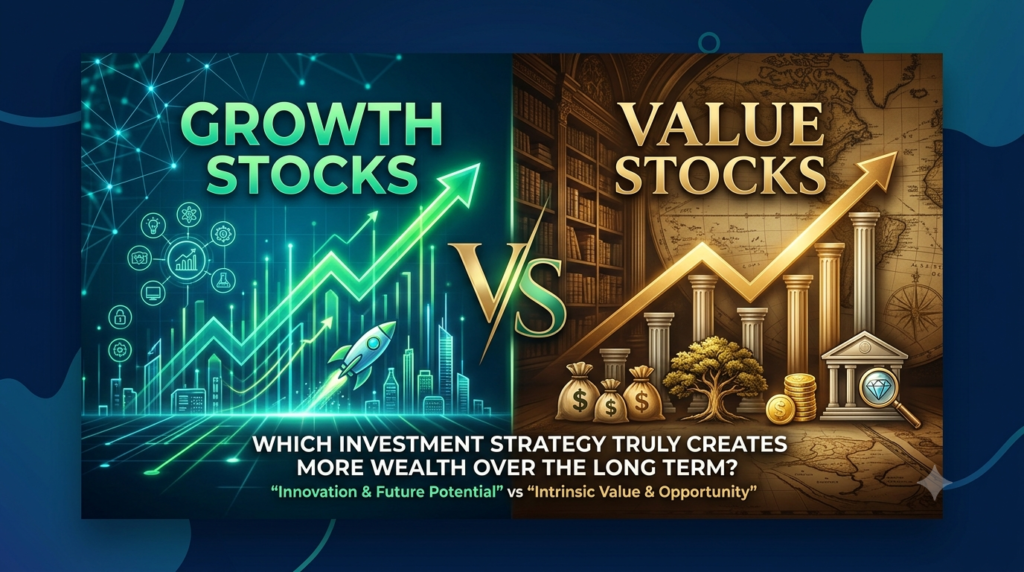
During periods of innovation and low interest rates, growth stocks often performed extremely well because investors placed greater value on future earnings.
On the other hand, value stocks often perform better during economic recoveries, inflationary periods, and times when investors prefer stable businesses with reliable profits.
Why Growth Stocks Have Created Massive Wealth
One reason growth stocks can generate incredible returns is because successful companies can expand for many years.
A company growing earnings by 20% or 30% annually can dramatically increase its value over time. Early investors benefit from this compounding effect.
Some major reasons growth stocks attract investors include:
- Powerful innovation: Technology and new industries can create entirely new markets.
- Scalable business models: Digital companies can grow without increasing costs at the same rate.
- Strong investor confidence: Successful growth companies often attract global attention.
- Long-term expansion opportunities: Emerging industries can provide decades of growth.
However, investors must remember that not every fast-growing company becomes successful. Many companies have high expectations built into their stock prices, and disappointing results can cause major losses.
Why Value Stocks Continue To Matter
Although growth stocks have dominated some recent periods, value investing remains an important strategy.
Value stocks often provide advantages that growth stocks may not offer:
- Lower valuations can provide a margin of safety.
- Dividend-paying companies can generate regular income.
- Established companies may survive difficult economic conditions.
- Investors may benefit when undervalued companies recover.
During market downturns, investors often move toward companies with strong balance sheets and consistent earnings. This can create opportunities for value investors.
A company does not need to be exciting to create wealth. Sometimes, businesses with boring products and predictable profits can become excellent long-term investments.
Which Strategy Has Made More Money Over Time?
The answer depends on the time period being analyzed.
Historically, value investing had a long advantage, especially from the early 20th century through parts of the 2000s. Investors who purchased undervalued companies often benefited as prices corrected toward their actual worth.
However, from the late 2000s through the early 2020s, growth stocks experienced a powerful period of success. Large technology companies delivered exceptional returns as digital transformation accelerated worldwide.
The reality is that market leadership changes.
There are periods when growth stocks dominate and periods when value stocks outperform.
Smart investors often avoid choosing only one side. Instead, they build diversified portfolios that include different types of companies.
Factors That Influence Growth and Value Stock Performance
Several economic factors determine which strategy performs better.
Interest Rates
Interest rates strongly affect growth stocks because their value often depends on future earnings. When interest rates are low, investors are usually more willing to pay higher prices for future growth.
When rates rise, future earnings become less valuable, which can pressure growth stock prices.
Economic Cycles
Different stages of the economy favor different strategies.
Growth stocks often perform well during expansion periods when investors expect strong business growth.
Value stocks may perform better during recoveries when investors look for companies that are priced attractively.
Market Sentiment
Investor emotions influence stock prices. During periods of excitement, growth companies may receive extremely high valuations. During fear-driven markets, value opportunities may appear.
Should You Invest in Growth Stocks or Value Stocks?
There is no universal answer because every investor has different goals.
Growth investing may suit investors who:
- Have a long investment timeline
- Accept higher volatility
- Believe in innovation-driven companies
- Want maximum capital appreciation
Value investing may suit investors who:
- Prefer lower-priced opportunities
- Like stable businesses
- Want dividend income
- Prefer a margin of safety
Many successful investors combine both approaches. A balanced portfolio can capture growth opportunities while maintaining stability through established companies.
Common Mistakes Investors Make
Many investors fail because they misunderstand these strategies.
Some common mistakes include:
- Buying growth stocks only because they are popular
- Assuming cheap stocks are always good investments
- Ignoring company fundamentals
- Selling during temporary market declines
- Following short-term market trends
A stock being expensive does not automatically mean it is bad. A stock being cheap does not automatically mean it is a bargain.
The quality of the business matters.
Final Thoughts: Growth Stocks vs Value Stocks
The debate between growth stocks vs value stocks will continue for generations because both strategies have created successful investors. Growth stocks have produced some of the greatest wealth-building stories in modern markets, while value stocks have rewarded patient investors who recognized opportunities others ignored.
The best strategy depends on your financial goals, investing style, and ability to handle market fluctuations. Instead of searching for one perfect approach, focus on understanding businesses, staying disciplined, and thinking long term.
Successful investing is not about predicting every market move. It is about making thoughtful decisions, allowing time to work in your favor, and building a strategy you can follow consistently.
Frequently Asked Questions (FAQs)
1. Are growth stocks riskier than value stocks?
Yes, growth stocks are usually considered more volatile because their prices often depend on future expectations. If growth slows, investors may quickly reduce their valuations.
2. Do value stocks always outperform growth stocks?
No. Value stocks have historically performed well over long periods, but growth stocks have dominated certain market cycles, especially during periods of technological innovation.
3. Can I invest in both growth and value stocks?
Yes. Many investors combine both strategies to create a diversified portfolio that balances growth potential and stability.
4. Which strategy is better for beginners?
Beginners often benefit from diversification rather than choosing only one strategy. Learning how both approaches work can help investors make better decisions.
5. How long should I hold growth or value stocks?
Both strategies generally work best with a long-term mindset. Short-term price movements can be unpredictable, but quality companies can create value over many years.