When you begin investing in the stock market, one of the first terms you’ll encounter is market capitalization explained. Whether you’re buying individual stocks or investing through mutual funds and ETFs, understanding market capitalization can help you make smarter financial decisions. It isn’t just another financial buzzword—it tells you how large a company is, the level of risk it may carry, and its potential for future growth. Investors, analysts, and fund managers rely on market capitalization every day to classify businesses and build diversified portfolios.
If you’ve ever wondered why companies like Apple and Microsoft are considered safer investments while smaller companies promise higher growth, the answer often lies in market capitalization explained. Simply put, market capitalization represents the total market value of a company’s outstanding shares. This single metric provides valuable insight into a company’s size, stability, and investment profile. Understanding it can help you decide whether large-cap, mid-cap, or small-cap stocks are the right fit for your financial goals.
What Is Market Capitalization?
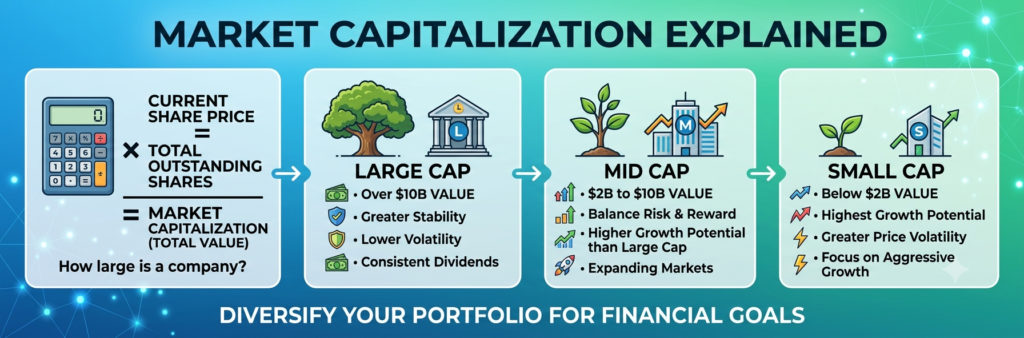
Market capitalization, commonly called market cap, is the total value of all outstanding shares of a publicly traded company. It is calculated using a straightforward formula:
Market Capitalization = Current Share Price × Total Outstanding Shares
For example, if a company has 100 million outstanding shares and each share trades at $50, its market capitalization is $5 billion. While this calculation appears simple, it offers investors a quick way to compare companies regardless of their stock price.
Many beginners mistakenly assume that a company with a higher stock price is automatically larger than another company. That’s not true. A $1,000 stock with only a few million shares may actually be much smaller than a $100 stock with billions of shares outstanding. That’s why market capitalization is considered a far more accurate measure of company size than share price alone.
Why Market Capitalization Matters
Understanding market capitalization helps investors evaluate risk, expected returns, and portfolio diversification. Companies of different sizes behave differently during economic expansions and downturns.
Market capitalization helps investors:
- Evaluate company size
- Measure investment risk
- Compare businesses within an industry
- Build diversified portfolios
- Select investments based on financial goals
Generally speaking, larger companies tend to have stable earnings and lower volatility, while smaller companies often experience faster growth but higher price swings. This relationship makes market capitalization one of the most important metrics in investing.
Understanding Large Cap Stocks
Large-cap companies typically have market capitalizations exceeding $10 billion, although exact definitions may vary slightly depending on the index provider. These companies are household names with established brands, experienced management teams, and long operating histories. Examples include Apple, Microsoft, Amazon, and Johnson & Johnson.
Large-cap stocks are often favored by conservative investors because they have demonstrated resilience across different market cycles. They usually generate consistent revenue, maintain strong cash flows, and often pay dividends to shareholders.
Benefits of Large Cap Stocks
- Greater financial stability
- Lower volatility
- Strong balance sheets
- Better access to capital
- Often pay regular dividends
The trade-off is that large companies may grow more slowly than emerging businesses because expanding an already massive company becomes increasingly difficult. Still, they remain the backbone of many investment portfolios due to their reliability.
Understanding Mid Cap Stocks
Mid-cap stocks generally represent companies valued between $2 billion and $10 billion. They occupy the “sweet spot” between stability and growth.
These businesses have usually moved beyond the risky startup phase but still possess significant room for expansion. Many successful large-cap companies were once mid-cap businesses before achieving broader market leadership.
Mid-cap companies often:
- Expand into new markets
- Introduce innovative products
- Increase profitability
- Acquire competitors
- Deliver above-average earnings growth
Many professional investors view mid-cap stocks as offering an attractive balance between risk and reward. Recent market analysis has highlighted that mid-cap companies may offer compelling long-term growth opportunities while maintaining more stability than smaller firms.
Understanding Small Cap Stocks
Small-cap companies usually have market capitalizations below $2 billion. These businesses are often younger, more specialized, and focused on aggressive growth.
Because they operate on a smaller scale, they can expand revenue much faster than established corporations. This growth potential attracts investors looking for higher long-term returns.
However, small-cap investing comes with additional risks:
- Greater price volatility
- Limited financial resources
- Higher sensitivity to economic slowdowns
- Lower trading liquidity
- Increased business uncertainty
Although small-cap stocks can produce exceptional returns, they also experience larger fluctuations during uncertain markets. Investors should carefully assess their risk tolerance before allocating significant portions of their portfolios to this segment.
Large Cap vs Mid Cap vs Small Cap Stocks
Choosing between large-cap, mid-cap, and small-cap stocks depends on your financial objectives.
Large Cap Stocks
- Best for conservative investors
- Lower volatility
- Stable earnings
- Dividend potential
- Long operating history
Mid Cap Stocks
- Balanced risk and reward
- Higher growth opportunities
- Increasing market share
- Moderate volatility
Small Cap Stocks
- Highest growth potential
- Greater risk
- Significant price swings
- Ideal for long-term investors comfortable with volatility
Rather than selecting only one category, many financial advisors recommend diversifying across all three to balance growth opportunities with portfolio stability.
How Market Capitalization Affects Your Investment Strategy
Your investment strategy should reflect your age, financial goals, and willingness to accept risk.
For example:
- Young investors with long investment horizons often allocate more money toward mid-cap and small-cap stocks.
- Investors nearing retirement generally increase exposure to large-cap companies because they tend to be more stable.
- Long-term investors frequently combine all market-cap categories to reduce portfolio volatility while maintaining growth potential.
Market capitalization should never be the only factor you evaluate. Revenue growth, profitability, debt levels, competitive advantages, and industry trends also deserve careful attention before investing.
Common Mistakes Investors Make
Many beginners misunderstand market capitalization and make avoidable mistakes.
Some common errors include:
- Confusing share price with company size.
- Investing only in large companies without considering growth opportunities.
- Buying small-cap stocks solely because they’re inexpensive.
- Ignoring diversification.
- Chasing recent market performance instead of focusing on long-term fundamentals.
Successful investing requires patience, research, and proper portfolio allocation rather than relying on a single metric.
Current Market Perspective
Recent market trends have shown that leadership can rotate between different market-cap categories. While large-cap technology companies have dominated many recent years, analysts have also highlighted periods where mid-cap and small-cap stocks outperform due to attractive valuations and stronger earnings growth opportunities. Investors should avoid assuming that one category will always deliver superior returns. Instead, maintaining diversification across market capitalizations can help reduce risk over the long term.
Conclusion
Understanding market capitalization explained gives investors one of the strongest foundations for making informed investment decisions. Market capitalization isn’t simply about how “big” a company is—it provides insight into its maturity, growth prospects, volatility, and potential role within a diversified portfolio.
Large-cap stocks offer stability and dependable performance, mid-cap stocks provide an attractive balance between growth and security, while small-cap stocks deliver exciting upside potential at the cost of increased risk. No single category is universally better than another. The ideal mix depends on your financial goals, investment horizon, and comfort with market fluctuations.
By combining companies across different market-cap categories and focusing on long-term investing rather than short-term market noise, investors can build stronger, more resilient portfolios.
Frequently Asked Questions
1. What is market capitalization in simple words?
Market capitalization is the total market value of a company’s outstanding shares. It is calculated by multiplying the current share price by the total number of shares.
2. Which is better: large-cap, mid-cap, or small-cap stocks?
None is universally better. Large caps offer stability, mid caps balance growth and risk, while small caps provide higher growth potential with greater volatility.
3. Is market capitalization the same as company value?
Not exactly. Market capitalization measures the value of a company’s equity. Enterprise value also includes debt and cash, providing a broader valuation.
4. Why do investors use market capitalization?
It helps investors compare company size, evaluate risk, diversify portfolios, and select investments aligned with their financial goals.
5. Can a company’s market capitalization change daily?
Yes. Since market capitalization depends on share price, it changes whenever the stock price moves during market trading.