Why $100 Is Enough to Begin
Breaking the Myth of Needing Thousands
For many years, investing was viewed as an activity reserved for wealthy individuals with large amounts of disposable income. This misconception still prevents countless beginners from entering the financial markets. In reality, modern investing platforms have transformed the landscape, making it possible to begin investing with as little as $100—and sometimes even less.
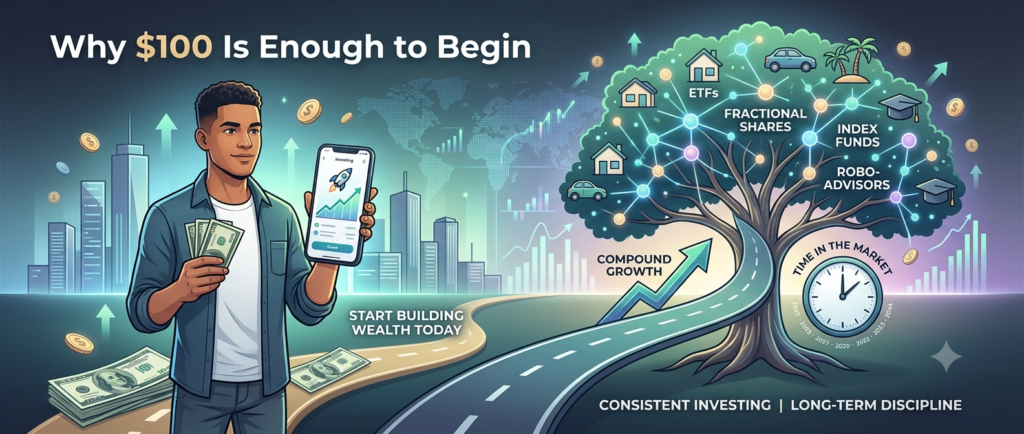
Technology has made investing more accessible through commission-free trading, fractional shares, and low-cost exchange-traded funds (ETFs). Instead of waiting until you’ve accumulated thousands of dollars, you can start building wealth immediately with a modest investment.
Starting with $100 may not make you rich overnight, but it helps you develop the most important investing habit: consistency. Every successful investor began somewhere, and your first investment is often more valuable as a learning experience than as a wealth-building tool.
By investing early, you also gain valuable experience in understanding market fluctuations, managing risk, and creating long-term financial discipline.
The Power of Starting Early
One of the biggest advantages of investing isn’t having more money—it’s having more time.
Thanks to compound growth, even small investments can grow significantly over decades. Compound interest allows your investment returns to generate additional returns, creating exponential growth over time.
For example:
- Invest $100 today.
- Add just $50 each month.
- Earn an average annual return of 8%.
Over 30 years, your portfolio could grow into tens of thousands of dollars—not because of your initial $100, but because you started early and invested consistently.
Time in the market almost always beats trying to perfectly time the market.
Set Your Financial Goals Before Investing
Short-Term vs Long-Term Goals
Before buying your first investment, determine why you’re investing.
Your investment strategy should align with your financial objectives.
Short-term goals (1–5 years):
- Emergency fund
- Vacation savings
- Buying a car
- Home down payment
Since you’ll need the money relatively soon, conservative investments or high-yield savings accounts may be more appropriate.
Long-term goals (10+ years):
- Retirement
- Financial independence
- Wealth building
- Children’s education
- Passive income
Long-term investors can usually tolerate more market volatility because they have enough time to recover from temporary downturns.
Having clearly defined goals helps you remain disciplined during market fluctuations.
Understanding Your Risk Tolerance
Risk tolerance refers to your ability and willingness to handle investment losses.
Ask yourself:
- Would you panic if your portfolio dropped 20%?
- Are you investing for decades or just a few years?
- Do you value stability over higher returns?
Generally:
- Younger investors often accept more risk because they have time to recover.
- Older investors usually prioritize preserving capital.
- Conservative investors may prefer bonds or diversified funds.
- Aggressive investors may allocate more toward stocks.
Knowing your risk tolerance helps you build a portfolio you’ll actually stick with during market volatility.
Where Can You Invest $100?
Exchange-Traded Funds (ETFs)
ETFs are one of the best investment choices for beginners.
An ETF owns dozens—or even hundreds—of different companies inside a single investment.
Benefits include:
- Instant diversification
- Low management fees
- Easy buying and selling
- Reduced risk compared to individual stocks
Popular ETFs often track major indexes like the S&P 500, allowing investors to own a small piece of America’s largest companies with one purchase.
For someone investing only $100, ETFs provide excellent diversification without requiring a large portfolio.
Fractional Shares
Many brokerages now allow investors to purchase fractional shares.
Instead of buying one full share of an expensive company, you can buy a fraction based on the amount you wish to invest.
For example:
- $20 in Apple
- $30 in Microsoft
- $25 in Amazon
- $25 in NVIDIA
This flexibility allows beginners to diversify even with limited capital.
Fractional investing removes one of the biggest barriers that previously prevented new investors from purchasing high-priced stocks.
Index Funds
Index funds are another excellent choice for beginners.
Rather than trying to outperform the market, index funds simply track a market index.
Advantages include:
- Low fees
- Broad diversification
- Historically strong long-term returns
- Passive management
Many financial experts recommend index funds because they consistently outperform most actively managed funds over long periods.
They require little maintenance, making them ideal for beginner investors.
Robo-Advisors
If choosing investments feels overwhelming, robo-advisors can help.
A robo-advisor asks questions about:
- Age
- Goals
- Risk tolerance
- Investment timeline
It then automatically builds and manages a diversified portfolio.
Additional benefits include:
- Automatic rebalancing
- Tax-efficient investing
- Low minimum investments
- Hands-off portfolio management
For beginners who prefer simplicity, robo-advisors offer an excellent starting point.
Step-by-Step Roadmap to Investing
Choose a Brokerage
Your brokerage account is where you’ll buy and hold investments.
When comparing brokerages, consider:
- No account minimums
- Zero trading commissions
- Fractional share investing
- User-friendly mobile app
- Educational resources
- Reliable customer support
Take time to compare available platforms before opening an account.
A good brokerage makes investing easier and encourages long-term consistency.
Fund Your Account
Once your brokerage account is approved:
- Link your bank account.
- Deposit your first $100.
- Wait for the funds to clear.
- Begin investing.
Avoid waiting for the “perfect” time.
Successful investors understand that consistent investing matters far more than perfect timing.
Build Your First Portfolio
A simple beginner portfolio could look like:
- 80% diversified ETF
- 20% individual stocks (optional)
Or even simpler:
- 100% S&P 500 index ETF
This approach offers instant diversification while minimizing unnecessary complexity.
As your investment knowledge grows, you can gradually add international funds, bonds, or sector-specific investments.
Automate Monthly Contributions
The easiest way to build wealth is through automation.
Set up automatic investments every month—even if it’s only:
- $25
- $50
- $100
Automating removes emotion from investing and encourages consistency.
This strategy also benefits from dollar-cost averaging, where you purchase investments at various market prices over time, reducing the impact of short-term volatility.
Small monthly contributions often become surprisingly large portfolios over decades.
Common Beginner Mistakes
Emotional Investing
Markets naturally rise and fall.
New investors often make costly mistakes by:
- Selling during market crashes
- Buying after prices have already surged
- Constantly checking their portfolio
- Reacting to alarming headlines
Successful investors stay focused on their long-term goals instead of short-term market movements.
Patience is often one of the greatest investing advantages.
Chasing Hot Stocks
Social media constantly promotes “the next big stock.”
Unfortunately, many beginners buy investments after they’ve already experienced significant price increases.
Instead of chasing trends:
- Invest consistently.
- Diversify broadly.
- Focus on long-term growth.
- Ignore market hype.
Building wealth usually comes from disciplined investing—not gambling on the latest market sensation.
Growing Beyond Your First $100
Your first $100 is only the beginning.
As your income grows, aim to:
- Increase monthly contributions.
- Reinvest dividends.
- Expand your diversification.
- Continue learning about investing.
- Review your portfolio periodically.
- Stay invested during market downturns.
Remember that investing is a marathon, not a sprint.
Many financially successful individuals didn’t start with large sums—they simply invested consistently over many years.
Your future wealth will likely depend more on your saving habits and consistency than on finding the perfect investment.
Conclusion
Starting your investment journey with just $100 is not only possible—it’s a smart way to begin building lifelong financial habits. Modern investment platforms have eliminated many traditional barriers, making it easier than ever to buy diversified investments, fractional shares, and low-cost index funds.
Rather than waiting until you have thousands of dollars, focus on taking the first step today. Set clear financial goals, understand your risk tolerance, choose investments that match your objectives, and commit to investing consistently over time.
Remember, successful investing isn’t about starting with a large amount of money. It’s about starting early, staying disciplined, and allowing time and compound growth to work in your favor.
FAQs
Can I really start investing with only $100?
Yes. Many brokerages allow you to begin investing with $100 or even less through fractional shares and low-cost ETFs.
What is the safest investment for beginners?
Diversified ETFs and index funds are generally considered among the safest long-term investment options because they spread risk across many companies.
Should I buy individual stocks or ETFs?
For most beginners, ETFs are a better choice because they provide instant diversification and lower overall risk.
How often should I invest?
Investing consistently—such as monthly—is usually more effective than trying to predict the best time to invest.
Can I lose money investing?
Yes. All investments carry some level of risk. However, maintaining a diversified portfolio and investing for the long term can help reduce the impact of short-term market fluctuations.