Why Independence Day Is the Perfect Time to Reflect on America’s Financial Journey
Every Independence Day reminds Americans of the country’s remarkable journey from thirteen colonies to one of the world’s largest economic powers. While fireworks, parades, and patriotic celebrations dominate the holiday, another story deserves attention—the incredible evolution of the American stock market. Over the last century, the United States has transformed into the global center of innovation, entrepreneurship, and investment, with its stock exchanges becoming the heartbeat of the world’s financial system.
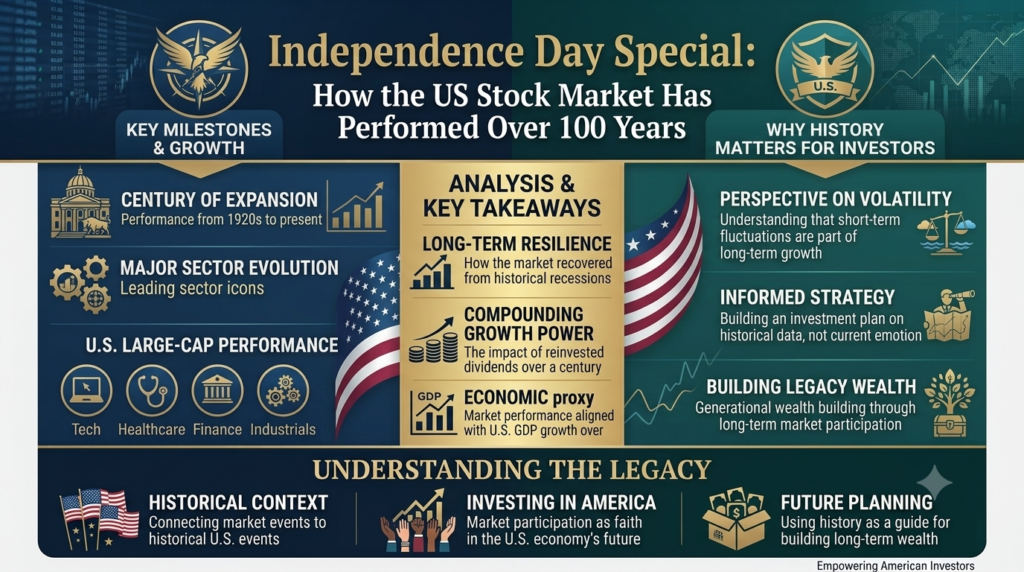
One of the best ways to understand America’s economic resilience is by exploring US stock market history. From historic crashes and painful recessions to technological revolutions and record-breaking rallies, the market has experienced nearly every imaginable challenge. Yet despite wars, inflation, pandemics, political uncertainty, and financial crises, US stock market history consistently demonstrates one remarkable pattern: long-term growth. Historical data shows that U.S. stocks have delivered approximately 8–10% average annual returns over extended periods, while data covering 1928–2024 continues to reinforce the power of long-term investing.
Understanding the US Stock Market History
When investors talk about America’s financial strength, they often point toward Wall Street, but the story extends far beyond New York City’s famous streets. The stock market represents thousands of companies across nearly every industry imaginable, from healthcare and manufacturing to artificial intelligence and renewable energy. These businesses collectively reflect the innovation and productivity that have powered American economic leadership for generations.
Looking at US stock market history reveals that wealth creation has never followed a perfectly straight line. Instead, it resembles climbing a mountain filled with steep hills, unexpected storms, and breathtaking views. Investors who remained patient during periods of uncertainty often experienced significant long-term rewards. Historical market research covering nearly a century demonstrates that despite numerous corrections and bear markets, diversified investors who stayed invested generally benefited from the market’s upward trajectory.
How the Market Became a Symbol of American Growth
The American stock market is much more than a place where investors buy and sell shares. It has become a powerful symbol of the nation’s economic confidence, entrepreneurial spirit, and ability to innovate. Every successful company that lists its shares on a public exchange represents years of hard work, calculated risks, and the ambition to solve real-world problems. As businesses grow, they create jobs, introduce groundbreaking products, and contribute to economic expansion. Investors, in turn, share in that growth by owning a small piece of these companies. This relationship between businesses and investors has helped transform the United States into one of the world’s strongest economies over the past century.
Throughout US stock market history, some of the world’s most influential companies have emerged from humble beginnings before becoming household names. Industries have continuously evolved—from railroads and steel manufacturing in the early twentieth century to automobiles, consumer goods, technology, cloud computing, biotechnology, and now artificial intelligence. Each new wave of innovation has introduced fresh investment opportunities while reshaping the economy. Although every generation has faced its own financial challenges, the market has consistently rewarded businesses capable of adapting to changing consumer needs and technological advancements. This remarkable ability to reinvent itself explains why the American stock market continues to attract investors from nearly every country around the globe.
Another reason the market symbolizes American growth is its resilience during times of crisis. Major events such as wars, recessions, oil shocks, inflationary periods, financial crises, and even global pandemics temporarily disrupted investor confidence. Yet history repeatedly shows that businesses adapted, earnings recovered, and markets eventually reached new highs. Investors who maintained discipline rather than reacting emotionally often benefited the most from these recoveries. The stock market, therefore, reflects not only economic performance but also the determination of American businesses to overcome adversity and continue moving forward.
Today’s market is increasingly driven by innovation. Companies investing heavily in artificial intelligence, renewable energy, semiconductor manufacturing, cybersecurity, healthcare technology, and advanced robotics are shaping the next chapter of economic growth. These sectors are attracting substantial capital because investors believe they will define the future of global commerce. As Independence Day celebrates America’s freedom and progress, the continued evolution of the stock market serves as another reminder that innovation remains one of the country’s greatest strengths.
The Evolution of Major Stock Exchanges
The journey of the American stock market would not be complete without understanding how its major exchanges evolved over the last century. The New York Stock Exchange (NYSE) has long been recognized as one of the world’s most prestigious financial marketplaces. Established centuries ago, it became the preferred destination for many of America’s largest corporations. Its strict listing standards, extensive regulatory framework, and reputation for stability attracted companies seeking long-term investor confidence. Over time, the NYSE evolved from bustling trading floors filled with shouting brokers into a highly sophisticated electronic marketplace capable of executing millions of transactions every day.
While the NYSE focused primarily on established corporations, the Nasdaq revolutionized investing after its launch in 1971. As the world’s first fully electronic stock exchange, Nasdaq introduced faster and more efficient trading while becoming the preferred home for technology companies. During the technology boom of the 1990s, businesses like Microsoft, Apple, Amazon, Intel, and later Alphabet, Meta, and NVIDIA helped transform Nasdaq into a global symbol of innovation. Its rise demonstrated how rapidly changing industries could reshape investment opportunities and influence the broader economy. The growing importance of technology stocks also changed how investors evaluated growth, profitability, and future potential.
Technology has dramatically transformed the way these exchanges operate. High-speed electronic trading, artificial intelligence, algorithmic systems, cloud infrastructure, and advanced cybersecurity measures have replaced many traditional manual processes. Investors can now execute trades within milliseconds from virtually anywhere in the world using online brokerage platforms and mobile applications. This accessibility has encouraged greater retail participation, making stock market investing available to millions of people who previously had limited access to financial markets.
The evolution of America’s stock exchanges reflects the broader story of US stock market history—one defined by continuous innovation, adaptation, and global leadership. These exchanges have successfully embraced new technologies while maintaining investor confidence through transparency and regulation. As financial markets continue evolving with digital assets, AI-powered analytics, and next-generation trading platforms, they remain central to America’s economic success. Their century-long transformation perfectly mirrors the nation’s ability to embrace change while continuing to create opportunities for businesses, investors, and future generations.
The Early Years: 1920s Prosperity and the Great Depression
The first few decades of the twentieth century laid the foundation for what would become one of the most fascinating chapters in US stock market history. Following World War I, the United States entered a period of extraordinary economic optimism. Factories expanded rapidly, consumer spending increased, and new technologies such as automobiles, household appliances, radios, and improved manufacturing processes transformed everyday life. Millions of Americans experienced rising incomes, creating an environment where investing in stocks became increasingly popular. For many families, the stock market represented a new path toward financial independence, and investor confidence reached unprecedented levels.
The rapid growth of the 1920s also introduced significant risks that many investors overlooked. Speculation became widespread, with people borrowing money to purchase stocks in hopes of making quick profits. Share prices often climbed much faster than the actual earnings of companies, creating a dangerous disconnect between market valuations and economic fundamentals. Newspapers celebrated soaring markets almost daily, encouraging even inexperienced investors to participate. While the excitement generated enormous wealth for some, it also created one of the largest financial bubbles in American history. Looking back today, economists frequently describe this period as an important lesson about balancing optimism with realistic expectations.
Despite the eventual collapse, the prosperity of the Roaring Twenties demonstrated the remarkable potential of America’s economy. Industries expanded, infrastructure improved, and entrepreneurship flourished across numerous sectors. Companies that survived the coming financial crisis would later become pillars of long-term economic growth. Investors studying this era learn that periods of extraordinary success can sometimes lead to excessive confidence, making disciplined investing more important than chasing short-term gains. This balance between opportunity and caution continues to shape investment strategies even a century later.
The Roaring Twenties
The decade known as the Roaring Twenties remains one of the most exciting periods in American economic history. Consumer culture exploded as families purchased automobiles, refrigerators, telephones, and other modern conveniences that had previously been considered luxuries. Companies expanded production to meet growing demand, and the stock market reflected this wave of optimism with impressive gains throughout much of the decade. Wall Street became synonymous with prosperity, attracting investors from all walks of life who believed economic growth would continue indefinitely.
Financial innovation also accelerated during this period. Investors increasingly used margin accounts, allowing them to borrow money to buy additional shares. While this strategy amplified profits during rising markets, it also significantly increased potential losses if prices declined. Unfortunately, many individuals underestimated this risk, assuming that stock prices would continue climbing forever. The widespread use of leverage added instability to an already overheated market, setting the stage for one of the most dramatic reversals in financial history.
The Roaring Twenties ultimately became a reminder that economic booms cannot continue without limits. Strong corporate performance, technological progress, and consumer confidence created genuine opportunities, but excessive speculation pushed valuations beyond sustainable levels. Modern investors frequently revisit this era because it highlights the importance of diversification, disciplined investing, and maintaining a long-term perspective instead of following market excitement.
The Historic Crash of 1929
October 1929 marked one of the most significant turning points in US stock market history. After years of remarkable gains, investor confidence suddenly collapsed as stock prices began falling sharply. Panic selling accelerated over several trading sessions, with millions of shares changing hands as investors rushed to limit their losses. The dramatic decline wiped out enormous amounts of wealth, severely damaging consumer confidence and triggering a chain reaction throughout the broader economy.
The market crash did not single-handedly cause the Great Depression, but it intensified existing economic weaknesses. Banks struggled with mounting losses, businesses reduced production, unemployment surged, and consumer spending declined sharply. Families who had invested their life savings faced devastating financial hardships, while companies delayed expansion plans amid growing uncertainty. The economic consequences lasted for years, fundamentally changing how governments, regulators, and investors approached financial markets.
One of the most important outcomes of the 1929 crash was the introduction of stronger financial regulations designed to protect investors and improve market transparency. Regulatory reforms helped restore confidence by requiring better corporate disclosures, increasing oversight, and reducing opportunities for market manipulation. These changes established many of the safeguards that continue to support today’s financial system. Although the crash remains one of the darkest moments in American investing, it also became a catalyst for building a more resilient and trustworthy stock market.
The lessons from 1929 remain remarkably relevant today. Markets naturally experience periods of optimism and fear, but history consistently shows that emotional decision-making often leads to poor investment outcomes. Investors who focus on quality businesses, diversify their portfolios, and remain committed to long-term goals are generally better positioned to navigate market volatility. As America celebrates Independence Day, reflecting on this pivotal chapter reminds us that resilience, learning from past mistakes, and adapting to change have always been essential ingredients of the nation’s economic success.
Post-War Economic Boom and Market Expansion
The years following World War II marked one of the most extraordinary periods of economic growth in American history. As soldiers returned home and industries shifted from wartime production to consumer goods, the United States entered an era of unprecedented prosperity. Millions of families purchased homes, automobiles, household appliances, and other products that fueled business expansion across multiple industries. Manufacturing reached record levels, employment remained strong, and rising wages increased disposable income. This combination of economic stability and consumer confidence created ideal conditions for the stock market to flourish. Investors who stayed committed during the difficult years of the Great Depression and World War II were rewarded as corporate earnings surged and stock prices reflected America’s growing economic strength.
This remarkable period occupies a special place in US stock market history because it demonstrated the power of long-term economic development. Companies expanded beyond domestic markets, global trade increased, and technological innovation accelerated at a pace few could have imagined just a decade earlier. Large corporations invested heavily in research, infrastructure, and product development, laying the foundation for future decades of growth. Investors increasingly recognized that buying shares in strong companies was not simply speculation—it was participation in the country’s expanding economy. Retirement plans, pension funds, and institutional investors also became more active participants, providing additional stability and liquidity to financial markets.
Government investment in highways, education, scientific research, and industrial development further strengthened economic momentum. The interstate highway system connected businesses across the nation, while advances in aviation, telecommunications, and healthcare opened entirely new markets. Consumer confidence remained high throughout much of the 1950s and 1960s, allowing businesses to generate consistent profits and expand operations. The stock market reflected this optimism as major indexes steadily climbed over time. Although occasional market corrections occurred, they were generally viewed as temporary setbacks within a much larger upward trend.
Perhaps the greatest lesson from the post-war boom is that sustainable economic growth depends on innovation, productivity, and confidence rather than short-term speculation. Investors who maintained diversified portfolios throughout these decades experienced substantial wealth creation as America’s economy matured into the world’s largest. This era continues to inspire modern investors because it illustrates how patience and belief in long-term business growth can outperform attempts to predict short-term market movements.
America’s Golden Economic Era
Many economists refer to the decades following World War II as America’s Golden Economic Era because of the exceptional combination of rising incomes, industrial expansion, technological progress, and strong productivity. Businesses invested aggressively in new factories, advanced machinery, and employee training, leading to higher output and improved living standards. Middle-class households expanded rapidly, creating sustained demand for products ranging from automobiles and televisions to home furnishings and financial services. These favorable economic conditions translated into healthier corporate earnings, making publicly traded companies increasingly attractive to investors.
One defining characteristic of this period was the emergence of globally recognized American corporations. Companies across sectors such as manufacturing, consumer goods, energy, pharmaceuticals, banking, and industrial equipment expanded their operations worldwide. As profits increased, shareholders benefited through rising stock prices and regular dividend payments. Investors began viewing equities as an essential component of long-term financial planning rather than merely speculative assets. This shift in public perception significantly increased participation in the stock market and strengthened the overall financial ecosystem.
Technological breakthroughs also played an important role in maintaining economic momentum. Advances in electronics, aerospace, medicine, and communications improved productivity while creating entirely new industries. Businesses capable of embracing innovation consistently outperformed competitors, reinforcing the importance of adaptability in long-term investing. Even today, analysts often compare emerging industries such as artificial intelligence and clean energy to the transformative innovations that fueled this golden era.
The success of this period demonstrates that economic prosperity is built over decades rather than months. Businesses that continuously invest in innovation, employee development, and operational efficiency are often best positioned for sustainable growth. Investors studying this chapter of history gain valuable insight into why patience remains one of the most powerful tools in wealth creation.
Rise of Consumer Industries
As prosperity spread across America, consumer-focused industries became major drivers of economic expansion. Rising household incomes encouraged families to spend more on automobiles, entertainment, housing, travel, healthcare, and retail products. Companies responded by expanding manufacturing capacity, improving product quality, and developing stronger national brands. This growing consumer economy fueled consistent corporate earnings growth, which in turn supported higher stock market valuations over many years.
Advertising also evolved into a powerful force during this era. Television became a central part of American households, allowing businesses to reach millions of potential customers through nationwide marketing campaigns. Strong brand recognition helped companies build customer loyalty and maintain steady revenue growth. Investors increasingly sought shares of businesses with recognizable brands because they often demonstrated reliable profitability even during periods of economic uncertainty.
The financial sector expanded alongside consumer industries by offering mortgages, personal loans, credit cards, and investment products to a growing middle class. Easier access to financing enabled families to purchase homes, vehicles, and household goods while supporting broader economic activity. Public companies operating in banking, insurance, retail, and manufacturing benefited from this expanding consumer base, further strengthening the stock market’s long-term performance.
Looking back today, the rise of consumer industries represents another defining chapter in US stock market history. It highlights how economic growth is driven not only by technological breakthroughs but also by everyday spending, business innovation, and rising living standards. The success of these industries created many of the globally recognized companies that continue to shape financial markets today. As America celebrates Independence Day, this remarkable period serves as a reminder that economic freedom, entrepreneurship, and consumer confidence have been essential pillars of the nation’s prosperity for more than a century.
Major Crashes That Shaped Modern Investing
No discussion of US stock market history is complete without examining the market crashes that tested investors’ confidence and reshaped financial regulations. While the stock market has generated impressive long-term returns, its journey has never been free from periods of fear and uncertainty. Every major decline has reminded investors that volatility is a natural part of investing rather than an exception. Although headlines during these events often predicted the end of economic growth, history repeatedly proved that the market possesses an extraordinary ability to recover. Companies adapted, governments introduced reforms, innovation continued, and patient investors eventually saw markets regain lost ground.
Market crashes often occur for different reasons. Some are triggered by excessive speculation, while others result from economic recessions, financial system failures, geopolitical uncertainty, or unexpected global events. Regardless of the cause, each downturn provides valuable lessons about diversification, risk management, emotional discipline, and maintaining a long-term investment strategy. Investors who panic and sell quality assets during periods of uncertainty frequently lock in losses, whereas those who remain focused on long-term fundamentals often benefit from future recoveries. This recurring pattern has become one of the defining characteristics of American financial markets.
Over the past century, several major downturns have permanently influenced investing practices and financial regulation. These events prompted stronger oversight, improved transparency, and better risk management across financial institutions. They also changed how investors evaluate company valuations, economic indicators, and portfolio diversification. While each crisis felt unique at the time, they collectively reinforced one timeless principle: successful investing depends more on patience and discipline than on attempting to predict every market movement.
The remarkable aspect of these downturns is not the declines themselves but the resilience that followed. New industries emerged, productivity improved, and businesses found innovative ways to grow despite economic challenges. This resilience continues to strengthen investor confidence and explains why the American stock market remains one of the world’s most attractive destinations for long-term capital.
Black Monday (1987)
On October 19, 1987, financial markets experienced one of the most dramatic single-day declines in history, an event now remembered as Black Monday. During one trading session, the S&P 500 suffered a massive drop, creating widespread panic among investors around the world. Advances in computerized trading systems and portfolio insurance strategies contributed to the rapid selling, amplifying losses far beyond what many market participants expected. The speed of the decline shocked both institutional and retail investors, raising serious concerns about the stability of modern financial markets.
Despite the severity of the crash, the broader economy remained relatively resilient. Unlike the Great Depression, Black Monday did not trigger a prolonged economic collapse. Businesses continued operating, corporate earnings remained relatively healthy, and investor confidence gradually returned over the following months. This distinction became an important lesson for investors, demonstrating that significant market declines do not always translate into deep economic recessions.
Regulators responded by introducing safeguards designed to reduce the likelihood of similar events. One of the most significant changes was the implementation of market-wide circuit breakers, which temporarily halt trading during periods of extreme volatility. These mechanisms give investors time to process information more rationally rather than making emotional decisions during periods of panic. Modern exchanges continue to use these protections as an important part of market stability.
Black Monday reinforced the importance of diversification and long-term thinking. Investors who resisted panic selling eventually benefited as markets recovered and continued their long-term upward trend. Today, this event serves as a reminder that short-term volatility should not overshadow decades of potential growth for disciplined investors.
Dot-Com Bubble
The late 1990s introduced one of the most exciting yet speculative periods in US stock market history. The rapid expansion of the internet transformed how businesses operated and how consumers accessed information. Investors became enthusiastic about technology companies, believing the digital revolution would permanently reshape the global economy. While that belief ultimately proved correct, many investors ignored one critical factor: company fundamentals. Businesses with little or no profit attracted enormous valuations simply because they operated online.
As excitement intensified, stock prices climbed to unsustainable levels. Initial public offerings attracted extraordinary attention, and technology shares often doubled or tripled within short periods. Investors feared missing out on the next big opportunity, fueling even greater speculation. Unfortunately, many companies lacked sustainable business models, and reality eventually caught up with investor expectations. When confidence faded in 2000, technology stocks experienced a sharp decline, erasing trillions of dollars in market value over the following years.
Although the collapse caused significant losses, it also separated genuine innovation from speculation. Companies with strong leadership, sustainable revenue, and scalable business models survived the downturn and eventually became some of the world’s most valuable corporations. Businesses such as Amazon continued investing through difficult periods and later emerged as global leaders, proving that quality companies can thrive even after severe market corrections.
The dot-com bubble teaches investors to distinguish between exciting stories and financially sound businesses. Innovation alone does not guarantee investment success; profitability, competitive advantages, and effective management remain essential. This lesson continues to guide investors evaluating today’s emerging technologies, including artificial intelligence, quantum computing, and advanced semiconductor development.
Global Financial Crisis (2008)
The Global Financial Crisis of 2008 became one of the most severe economic disruptions since the Great Depression. Unlike earlier market crashes driven primarily by speculation, this crisis originated within the financial system itself. Years of excessive mortgage lending, rising housing prices, and complex financial products created vulnerabilities that many institutions underestimated. When housing prices began falling and mortgage defaults increased, banks and investment firms faced mounting losses, triggering a global financial panic.
Stock markets around the world declined sharply as investor confidence collapsed. Financial institutions struggled with liquidity, businesses reduced investment, unemployment increased, and consumers became more cautious with spending. Governments and central banks responded with unprecedented measures, including emergency financial support, interest rate reductions, and large-scale economic stimulus programs. These actions helped stabilize financial markets and gradually restore confidence.
One of the lasting outcomes of the crisis was the introduction of stronger banking regulations and improved oversight of financial institutions. Stress testing, higher capital requirements, and enhanced risk management standards were implemented to strengthen the financial system against future shocks. Investors also became more aware of the importance of portfolio diversification and understanding the risks associated with complex financial products.
Despite the magnitude of the crisis, the years that followed demonstrated the remarkable resilience of the American economy. Innovation accelerated, corporate earnings recovered, and technology companies led one of the strongest bull markets in modern history. Investors who remained committed to long-term investing eventually witnessed markets reach new record highs. This chapter reinforces one of the greatest lessons from US stock market history: every major crisis has eventually been followed by recovery, innovation, and renewed economic growth for those willing to remain patient.
The Technology Revolution and the Bull Market
The recovery following the 2008 financial crisis ushered in one of the longest and most influential bull markets in American history. Technology became the driving force behind economic growth, fundamentally changing how people communicate, shop, work, invest, and entertain themselves. Companies specializing in cloud computing, e-commerce, social media, smartphones, cybersecurity, and digital payments transformed entire industries while creating enormous value for shareholders. Investors increasingly shifted their attention toward businesses capable of delivering scalable growth through innovation rather than relying solely on traditional industries. As these companies expanded globally, their influence extended far beyond the United States, making the American stock market the center of technological investment worldwide.
Another defining feature of this era was the rapid adoption of digital transformation across nearly every sector. Healthcare providers embraced telemedicine, manufacturers introduced automation, financial institutions accelerated online banking, and retailers invested heavily in e-commerce platforms. These technological improvements increased productivity while creating new investment opportunities that had not existed only a decade earlier. The COVID-19 pandemic further accelerated many of these trends, reinforcing the importance of digital infrastructure and remote services. Investors who recognized these long-term structural changes benefited as technology companies became some of the largest businesses by market capitalization.
Artificial intelligence has now become the newest chapter in this ongoing technological revolution. Businesses are integrating AI into customer service, healthcare diagnostics, software development, manufacturing, cybersecurity, and financial analysis. Companies leading AI innovation have attracted significant investor attention because they are expected to influence economic productivity for years to come. Although valuations continue to evolve, many analysts believe artificial intelligence could represent a transformational opportunity similar to the rise of the internet during the late twentieth century.
The technology revolution illustrates an important principle that has remained consistent throughout US stock market history: innovation drives long-term economic growth. Companies capable of adapting to changing consumer needs and technological advancements tend to outperform over extended periods. While market volatility remains inevitable, businesses that continuously innovate often create lasting value for both customers and shareholders.
FAANG Stocks and Innovation
The emergence of the FAANG companies—Facebook (now Meta), Apple, Amazon, Netflix, and Google (Alphabet)—changed the investment landscape dramatically. These organizations demonstrated how digital platforms could scale globally while generating extraordinary revenue growth and profitability. Their influence extended into advertising, cloud computing, consumer electronics, streaming entertainment, artificial intelligence, and digital commerce, making them some of the most closely followed companies in the world.
Investors were drawn to these companies because of their consistent innovation and ability to disrupt traditional industries. Rather than competing solely on price, they focused on technology, customer experience, and continuous product improvement. Their business models generated recurring revenue streams while benefiting from expanding global user bases. As these companies matured, they became major components of leading stock market indexes, significantly influencing overall market performance.
The success of FAANG companies also inspired a new generation of startups and entrepreneurs. Venture capital investment increased substantially as investors searched for the next transformative technology company. This entrepreneurial ecosystem strengthened America’s leadership in innovation and reinforced the country’s position as a global destination for investment capital. While not every technology startup succeeds, the environment continues to encourage creativity and long-term business development.
Their journey demonstrates that sustainable competitive advantages often matter more than short-term market excitement. Businesses with strong leadership, scalable products, and consistent innovation are better positioned to navigate economic uncertainty while delivering shareholder value over many years.
Artificial Intelligence Driving Growth
Artificial intelligence represents one of the most exciting developments shaping today’s financial markets. Companies are investing billions of dollars in AI research, advanced computing infrastructure, semiconductor manufacturing, and machine learning applications. These investments aim to improve efficiency, automate repetitive tasks, enhance decision-making, and create entirely new products and services. Investors view AI as a long-term growth driver because its applications span virtually every major industry.
The demand for AI has also accelerated growth in supporting industries such as cloud computing, data centers, networking equipment, and advanced semiconductor production. Businesses supplying the infrastructure required for AI development have experienced increased investor interest as organizations continue expanding their technological capabilities. This interconnected ecosystem demonstrates how innovation often creates opportunities far beyond a single industry.
Despite the enthusiasm surrounding AI, experienced investors recognize the importance of evaluating company fundamentals alongside technological potential. Revenue growth, profitability, competitive positioning, and effective management remain essential factors when assessing investment opportunities. History shows that while revolutionary technologies create enormous opportunities, successful investing still requires careful analysis and a long-term perspective.
As America celebrates another Independence Day, artificial intelligence symbolizes the nation’s continued commitment to innovation and entrepreneurship. Just as previous generations transformed transportation, manufacturing, telecommunications, and the internet, today’s innovators are laying the groundwork for the next era of economic expansion.
What 100 Years of Data Reveal
Examining more than a century of market performance reveals a remarkably consistent message: patience has historically been rewarded. Although investors have experienced devastating crashes, economic recessions, inflation, geopolitical conflicts, and unexpected global events, the broader trend has remained upward over long investment horizons. This resilience is supported by economic growth, corporate innovation, productivity improvements, and the ability of businesses to adapt to changing conditions.
Historical data also shows that attempting to predict every market movement is significantly more difficult than remaining invested through market cycles. Missing only a handful of the market’s strongest recovery days can substantially reduce long-term returns. Investors who consistently invested through both good and bad markets generally outperformed those who repeatedly entered and exited based on short-term headlines.
Some of the most valuable lessons from the past century include:
- Stay invested during market volatility instead of reacting emotionally.
- Diversify investments across sectors and industries.
- Focus on high-quality companies with sustainable business models.
- Maintain a long-term investment horizon rather than chasing short-term trends.
- View market corrections as a normal part of investing, not a reason to panic.
These principles have remained relevant across multiple generations and continue guiding successful investors today.
Independence Day 2026: Looking Ahead
Independence Day is not only a celebration of American freedom but also an opportunity to appreciate the nation’s extraordinary economic journey. From the industrial revolution to artificial intelligence, the United States has repeatedly demonstrated its ability to innovate, overcome adversity, and create opportunities for future generations. The stock market reflects this progress by serving as a living record of entrepreneurship, technological advancement, and corporate resilience.
Looking ahead, emerging sectors such as artificial intelligence, renewable energy, biotechnology, advanced manufacturing, quantum computing, and cybersecurity are expected to influence the next phase of economic growth. While challenges such as inflation, geopolitical uncertainty, and changing global trade dynamics will continue to affect markets, history suggests that innovation and adaptability remain America’s greatest competitive advantages.
For investors, the greatest takeaway from US stock market history is simple: short-term uncertainty has always existed, but long-term optimism has consistently prevailed. Independence Day serves as a reminder that resilience, determination, and innovation are qualities deeply rooted in both the nation’s history and its financial markets.
Conclusion
Over the past 100 years, the American stock market has weathered historic crashes, global wars, economic recessions, financial crises, pandemics, and technological revolutions. Despite these challenges, it has consistently demonstrated remarkable resilience by recovering, evolving, and reaching new milestones. The journey reflects far more than rising stock prices—it tells the story of entrepreneurship, innovation, and the enduring strength of the American economy.
Studying US stock market history reminds us that successful investing is built on patience, discipline, and confidence in long-term growth rather than reacting to temporary market fluctuations. Every generation has faced uncertainty, yet each has also witnessed new opportunities emerge through innovation and economic progress. As Americans celebrate Independence Day, this century-long financial journey stands as another powerful example of how resilience and vision continue to shape the nation’s future.
Frequently Asked Questions
1. Why is the US stock market considered one of the strongest in the world?
It benefits from a diverse economy, transparent regulations, innovative companies, deep liquidity, and strong investor participation from around the globe.
2. What is the average long-term return of the US stock market?
Historically, the U.S. stock market has delivered approximately 8–10% average annual returns over extended periods, although yearly performance varies significantly.
3. What was the biggest stock market crash in American history?
The 1929 stock market crash remains one of the most significant events, leading to the Great Depression and major financial reforms.
4. How has technology influenced the stock market?
Technology has transformed trading, created entirely new industries, improved business productivity, and produced many of the world’s largest publicly traded companies.
5. What is the biggest lesson from 100 years of market history?
The most important lesson is that disciplined, long-term investing has historically outperformed emotional decision-making during periods of market volatility.