If you’ve ever watched financial news or browsed investment websites, you’ve probably heard people talking about the S&P 500. Analysts mention it almost every day, retirement experts recommend it regularly, and experienced investors often compare their portfolios against it. Yet many Americans still wonder what it actually is and why it matters so much. Understanding this famous stock market index is one of the first and most valuable lessons anyone can learn before investing. Whether you’re saving for retirement, building wealth, or simply trying to understand the economy, the S&P 500 deserves your attention.
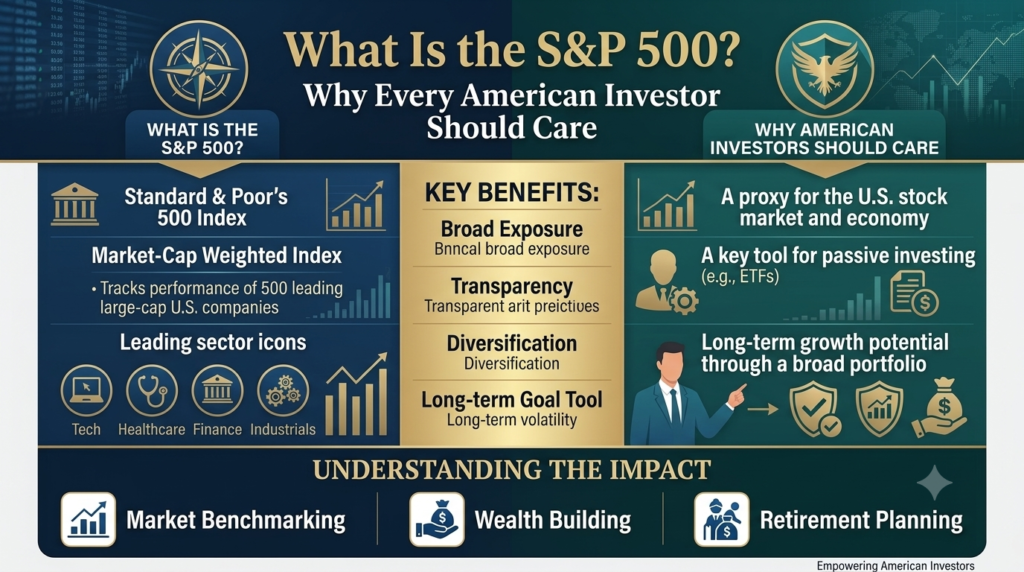
Simply put, what is S&P 500? The S&P 500 (Standard & Poor’s 500 Index) is a stock market index that tracks around 500 of the largest publicly traded companies in the United States. Although it represents approximately 500 companies, the index currently contains 503 stocks because a few companies have multiple share classes. Together, these businesses account for roughly 80% of the total value of the U.S. stock market, making the index one of the most accurate indicators of America’s economic health. Financial experts and investment firms worldwide rely on it as the benchmark for measuring stock market performance.
Unlike investing in a single company, the S&P 500 gives investors exposure to businesses across numerous industries, including technology, healthcare, finance, consumer goods, energy, industrials, and communication services. Companies such as Apple, Microsoft, Amazon, NVIDIA, Alphabet, Berkshire Hathaway, and JPMorgan Chase are among its largest members. Because these businesses generate trillions of dollars in revenue every year and operate globally, changes in the index often reflect broader economic trends rather than the success or failure of one company alone. This is exactly why understanding what is S&P 500 can help investors make smarter long-term financial decisions instead of reacting emotionally to short-term market fluctuations.
Understanding the Basics of the S&P 500
The S&P 500 was officially introduced in 1957 and has become one of the world’s most recognized stock market benchmarks. Instead of tracking every publicly traded company in America, it focuses on the largest corporations that meet strict financial and liquidity requirements. A committee at S&P Dow Jones Indices regularly reviews eligible companies to ensure the index continues representing leading businesses across different sectors. Companies that no longer qualify may be removed, while stronger businesses are added over time.
This process keeps the index relevant even as the economy changes. Decades ago, manufacturing and industrial companies dominated the market, while today technology firms occupy many of the largest positions. The index naturally evolves alongside America’s economy without requiring investors to constantly buy and sell individual stocks themselves. That dynamic structure has helped the S&P 500 remain one of the most respected indicators of long-term economic growth.
One of the reasons investors trust this index is its broad diversification. Instead of depending on one successful business, investors benefit from hundreds of established companies operating in different industries. Even if one company struggles, others may continue growing, reducing overall investment risk compared to buying only individual stocks.
How the S&P 500 Works
Many beginners assume every company in the S&P 500 contributes equally, but that’s not the case. The index uses a market capitalization weighting system, meaning larger companies have a greater influence on its daily performance. If Apple or Microsoft rises significantly, the index usually moves more than if a smaller company experiences the same percentage gain.
Market capitalization simply means the total value of a company’s outstanding shares. Companies with larger market values naturally receive greater weight because they represent a larger portion of the U.S. economy. This approach reflects real-world economic influence rather than assigning equal importance to every business.
Today, technology companies represent one of the largest portions of the index, which has contributed significantly to recent gains driven by artificial intelligence and semiconductor innovation. Recent market activity has shown that a relatively small number of large technology companies continue to influence overall S&P 500 performance, illustrating both the strength and concentration of the index.
Why the S&P 500 Matters to Investors
If there is one investment benchmark that both professionals and beginners pay attention to, it is the S&P 500. Every day, financial news channels report whether the index is up or down because it reflects the performance of many of America’s most influential companies. Instead of following hundreds of individual stocks, investors can simply watch this single index to understand the overall direction of the U.S. stock market. That simplicity is one of the biggest reasons why millions of people use it as their primary investment benchmark. When people ask what is S&P 500, they’re really asking why it has become the gold standard for measuring the strength of the American economy and stock market.
The index includes companies from nearly every major industry, including technology, healthcare, banking, consumer products, industrial manufacturing, energy, and communications. Because of this wide representation, the S&P 500 provides a realistic snapshot of corporate America. When many of these companies report strong earnings, the index often rises, reflecting growing business confidence and consumer spending. On the other hand, economic slowdowns, inflation concerns, or geopolitical events can negatively affect corporate profits, causing the index to decline. Investors, economists, and policymakers all monitor these movements because they offer valuable insights into market sentiment and the health of the economy.
Perhaps the biggest reason investors trust the S&P 500 is its impressive long-term track record. Although no investment guarantees profits, the index has historically delivered average annual returns of around 10% before inflation over long periods. There have certainly been difficult years, including major declines during financial crises, the COVID-19 pandemic, and periods of economic uncertainty. However, history has repeatedly shown that the market has recovered from downturns and continued to reach new highs over time. This resilience explains why financial advisors often encourage long-term investing instead of trying to predict short-term market movements.
Another important reason the S&P 500 matters is that countless investment products are built around it. Retirement accounts, pension funds, ETFs, mutual funds, and institutional portfolios often use the index as their benchmark. If a fund manager cannot consistently outperform the S&P 500 after fees, many investors question whether active management is worth the additional cost. As a result, the index has become much more than just a collection of stocks—it serves as the measuring stick for investment success across the financial industry.
Benefits of Investing in the S&P 500
One of the greatest advantages of investing in the S&P 500 is instant diversification. Rather than putting all your money into one or two companies, you gain exposure to hundreds of America’s largest and most successful businesses with a single investment. These companies operate across multiple industries and generate revenue from customers around the world. If one sector experiences a slowdown, another may continue growing, helping reduce the overall impact on your portfolio. Diversification doesn’t eliminate risk, but it significantly lowers the danger associated with relying on a single company’s performance.
Another major benefit is the simplicity of passive investing. Instead of spending hours researching quarterly earnings reports, monitoring daily news, or attempting to predict which stock will outperform next year, investors can simply purchase an S&P 500 index fund and let the market work over time. This “buy and hold” strategy removes much of the emotional decision-making that often hurts investors. Many studies have shown that investors who remain disciplined and stay invested during market downturns often achieve better long-term results than those who constantly trade in and out of the market.
Low investment costs are another reason the S&P 500 has become so popular. Because index funds simply track the benchmark instead of paying teams of analysts to select stocks, they usually charge significantly lower management fees than actively managed funds. While the difference between a small fee and a large fee may seem insignificant in a single year, it can amount to tens of thousands of dollars over several decades due to the power of compound growth. Keeping investment costs low allows more of your money to remain invested and continue earning returns year after year.
Some additional advantages include:
- Broad exposure to approximately 500 leading U.S. companies.
- Historically strong long-term returns compared with many other investment strategies.
- Low management expenses through index ETFs and mutual funds.
- Excellent liquidity, allowing investors to buy and sell easily.
- Ideal for retirement accounts, including IRAs and 401(k) plans.
- Automatic portfolio updates as companies are added or removed from the index.
- Reduced company-specific risk through diversification.
Beyond these practical benefits, investing in the S&P 500 also provides psychological advantages. Many investors make costly mistakes by chasing hot stocks or selling during market corrections. Owning a diversified index fund encourages patience and long-term thinking, making it easier to ignore short-term market noise. Rather than worrying about individual earnings announcements every quarter, investors can focus on consistently contributing to their portfolios and allowing compound growth to work over decades. This disciplined approach has helped countless Americans build wealth and achieve financial independence.
Risks Every Investor Should Understand
While the S&P 500 has built a reputation as one of the safest long-term stock investments, it is important to remember that no investment is completely risk-free. Every investor, regardless of experience, should understand that the index can experience periods of sharp declines. Stock markets naturally move through cycles of growth and contraction, influenced by inflation, interest rates, corporate earnings, political uncertainty, global conflicts, and economic recessions. During these challenging periods, even the strongest companies can lose value, causing the entire index to fall. Investors who expect constant gains often panic during market downturns, but history shows that temporary losses are a normal part of long-term investing.
Market volatility is perhaps the most noticeable risk. It is not unusual for the S&P 500 to decline by 10% or more during a market correction, and severe bear markets can produce even larger losses. These movements can be emotionally difficult, especially for new investors who have never experienced a major downturn. Selling investments during periods of fear often locks in losses and prevents investors from benefiting when markets recover. Successful long-term investors understand that volatility is simply the price paid for the opportunity to earn higher returns than traditional savings accounts or government bonds. Patience and discipline are often far more valuable than trying to predict every market movement.
Another important consideration is the growing concentration of the index in a relatively small number of mega-cap technology companies. Businesses such as Apple, Microsoft, NVIDIA, Amazon, Alphabet, and Meta Platforms represent a significant percentage of the index’s total value. While these companies have delivered exceptional growth in recent years, their large weighting means that their performance can heavily influence the overall direction of the S&P 500. If several of these major technology firms experience disappointing earnings or face regulatory challenges, the index may decline even if many smaller companies continue performing well. Investors should recognize that diversification within the index does not completely eliminate concentration risk.
Investors should also remember that the S&P 500 focuses exclusively on large-cap U.S. companies. It does not include smaller American businesses or international companies that may provide additional growth opportunities. For this reason, some financial advisors recommend combining S&P 500 investments with international stock funds, small-cap funds, or bond investments to create a more balanced portfolio. Understanding these limitations helps investors build realistic expectations and develop a diversified investment strategy that aligns with their long-term financial goals rather than relying on a single index alone.
Ways to Invest in the S&P 500
The good news is that investing in the S&P 500 has never been easier. Unlike decades ago, when investing often required large amounts of money and the assistance of a stockbroker, today’s investors can gain exposure to the index with only a small initial investment. Online brokerage platforms have made investing accessible to nearly everyone, allowing beginners to start building wealth with just a few dollars. Whether your goal is retirement planning, long-term wealth creation, or simply learning about investing, there are several convenient ways to own a piece of America’s largest companies.
One of the most popular options is investing through Exchange-Traded Funds (ETFs). These funds trade on stock exchanges just like individual stocks and are designed to mirror the performance of the S&P 500. Well-known ETFs such as SPDR S&P 500 ETF (SPY), Vanguard S&P 500 ETF (VOO), and iShares Core S&P 500 ETF (IVV) are widely used by both beginner and experienced investors. They offer low expense ratios, excellent liquidity, and the flexibility to buy or sell shares throughout the trading day. Because ETFs combine diversification with affordability, they have become one of the preferred investment vehicles for long-term investors.
Another excellent choice is an S&P 500 Index Mutual Fund. Unlike ETFs, mutual funds are typically purchased directly through investment companies and are priced only once at the end of each trading day. Many retirement plans, including 401(k)s and Individual Retirement Accounts (IRAs), offer index mutual funds as core investment options. Investors who prefer automatic monthly contributions often appreciate mutual funds because they make consistent investing simple and convenient. Over time, regularly investing fixed amounts—regardless of market conditions—can help reduce the impact of short-term price fluctuations through a strategy known as dollar-cost averaging.
Before investing, it’s important to compare different funds rather than choosing the first one you find. Consider factors such as expense ratios, minimum investment requirements, tracking accuracy, dividend reinvestment options, and the reputation of the fund provider. Even small differences in annual fees can significantly affect your investment returns over several decades due to compound growth. By selecting a low-cost, well-managed index fund and maintaining a long-term perspective, investors can maximize the potential benefits of owning the S&P 500 while keeping unnecessary costs to a minimum.
Is the S&P 500 Right for Beginners?
For many people taking their first steps into investing, the S&P 500 is often considered one of the smartest places to begin. New investors frequently worry about choosing the “perfect” stock, but that pressure disappears when investing in an index that already contains hundreds of America’s largest and most successful companies. Instead of relying on a single business to perform well, your investment is spread across multiple industries, providing built-in diversification. This makes the S&P 500 an attractive option for those who want long-term growth without constantly monitoring the stock market every day.
Another reason beginners appreciate the S&P 500 is its simplicity. You don’t need to become an expert in reading financial statements or predicting quarterly earnings reports. By investing consistently over many years, you can benefit from the long-term growth of the U.S. economy. This strategy is particularly effective when combined with regular monthly investments, allowing you to purchase more shares when prices are lower and fewer shares when prices are higher. Over time, this disciplined approach can reduce the emotional impact of market fluctuations and encourage better investing habits.
The index is also highly accessible. Many online brokerage platforms allow investors to purchase fractional shares, meaning you don’t need thousands of dollars to get started. Even small, consistent contributions can grow significantly through the power of compound returns. For younger investors especially, starting early can make a remarkable difference because investment gains have decades to accumulate. Time in the market has historically proven to be more valuable than trying to perfectly time the market.
That said, beginners should remember that investing in the S&P 500 requires patience. Stock prices will rise and fall, and there will inevitably be periods when your portfolio loses value temporarily. These moments can be uncomfortable, but they are a normal part of investing. Rather than reacting emotionally to short-term headlines, successful investors focus on their long-term financial goals. Maintaining a diversified portfolio, continuing regular contributions, and avoiding panic selling are habits that have historically rewarded patient investors over the long run.
Tips Before Investing
If you’re considering investing in the S&P 500, keep these practical tips in mind:
- Define your financial goals before investing.
- Build an emergency fund before putting money into the stock market.
- Invest regularly instead of waiting for the “perfect” time.
- Choose low-cost index funds to maximize long-term returns.
- Reinvest dividends whenever possible to accelerate compound growth.
- Stay invested during market downturns rather than making emotional decisions.
- Review your portfolio periodically, but avoid checking it every day.
- Think long term—the S&P 500 is designed for years, not weeks.
Following these principles won’t eliminate market risk, but they can help you become a more confident and disciplined investor. Building wealth is rarely about finding shortcuts; it’s about making smart decisions consistently and allowing time to work in your favor.
Final Verdict
If you’ve been asking what is S&P 500, the answer is much more meaningful than simply calling it a stock market index. It represents the strength, innovation, and long-term growth potential of America’s largest publicly traded companies. For decades, it has served as the benchmark against which countless investment strategies are measured, and it remains one of the most trusted tools for building long-term wealth. While no investment is guaranteed to produce profits, the combination of diversification, low costs, and historical performance has made the S&P 500 a cornerstone of millions of retirement portfolios.
Understanding what is S&P 500 empowers investors to make informed financial decisions rather than relying on speculation or chasing short-term market trends. Whether you’re investing for retirement, saving for your family’s future, or simply beginning your financial journey, the S&P 500 offers a straightforward and proven way to participate in the growth of the U.S. economy. By investing consistently, staying patient during periods of volatility, and maintaining a long-term perspective, you give yourself the opportunity to benefit from decades of economic expansion and corporate innovation.
Conclusion
The S&P 500 remains one of the most influential investment benchmarks in the world because it captures the performance of America’s leading companies across multiple industries. It provides investors with diversification, affordability, transparency, and the opportunity to participate in the long-term growth of the U.S. economy without the complexity of selecting individual stocks. Although market downturns are inevitable, history has repeatedly demonstrated that patient investors who remain committed to their long-term strategies have often been rewarded over time.
Whether you’re a complete beginner or an experienced investor looking to strengthen your portfolio, learning what is S&P 500 is an essential step toward smarter investing. The index is not a shortcut to instant wealth, but it is a powerful tool that has helped millions of Americans build financial security through disciplined, long-term investing. By focusing on consistency instead of short-term market noise, you can position yourself to benefit from the growth of some of the world’s most successful companies for years to come.
Frequently Asked Questions (FAQs)
1. What is the S&P 500 in simple terms?
The S&P 500 is a stock market index that tracks approximately 500 of the largest publicly traded companies in the United States. It is widely used as a benchmark for measuring the overall performance of the U.S. stock market.
2. Is investing in the S&P 500 safe?
While no investment is completely risk-free, the S&P 500 is generally considered one of the safer stock market investments because it offers broad diversification across many industries. However, investors should still be prepared for market volatility.
3. Can beginners invest in the S&P 500?
Yes. The S&P 500 is one of the best investment options for beginners due to its simplicity, diversification, and availability through low-cost ETFs and index mutual funds.
4. How much money do I need to invest in the S&P 500?
Many brokerage platforms allow investors to start with very small amounts through fractional shares or low minimum investment index funds, making it accessible for almost any budget.
5. Why do financial experts recommend the S&P 500?
Financial experts often recommend the S&P 500 because of its long history of strong performance, low investment costs, broad diversification, and ability to reflect the overall growth of the U.S. economy.