If you’ve ever searched for a company on the stock market, you’ve probably noticed that some stocks trade on the New York Stock Exchange (NYSE) while others are listed on NASDAQ. At first glance, both exchanges may seem identical because they allow investors to buy and sell stocks. However, each exchange operates differently, follows unique listing requirements, and attracts different types of companies. Understanding these differences can help investors make better decisions and gain a clearer picture of how the financial markets work.
One of the most searched questions among beginner investors is the NYSE vs NASDAQ difference. While both exchanges play a vital role in the U.S. economy, they differ in trading systems, company profiles, market makers, and overall investment experience. Knowing the NYSE vs NASDAQ difference is especially useful when researching stocks, comparing investment opportunities, or simply understanding why companies choose one exchange over another. Whether you’re investing for retirement, building a diversified portfolio, or just curious about the stock market, this guide will explain everything in simple language.
Understanding the Basics of Stock Exchanges
A stock exchange is a marketplace where investors buy and sell shares of publicly traded companies. Think of it as a giant marketplace where buyers and sellers meet electronically or physically to trade ownership in businesses. Companies list their shares on an exchange to raise capital, while investors purchase those shares hoping the company will grow and increase in value over time.
The United States has two dominant stock exchanges: the New York Stock Exchange (NYSE) and NASDAQ. Together, these exchanges list thousands of companies worth trillions of dollars. Although they serve the same purpose, their history, technology, and methods of operation are significantly different. Understanding how each exchange functions provides valuable insight into the financial markets and helps investors interpret stock information more effectively.
What Is the NYSE?
The New York Stock Exchange (NYSE) is the world’s oldest and one of the largest stock exchanges. Established in 1792, it has built a reputation as the home of many of America’s most established and financially stable corporations. The NYSE is located on Wall Street in New York City and is widely recognized as a symbol of global finance.
Unlike fully electronic exchanges, the NYSE combines electronic trading with designated market makers who help maintain orderly markets and improve liquidity. These professionals facilitate trades during periods of heavy buying or selling, helping reduce price volatility. Many blue-chip companies choose the NYSE because of its prestige, strong regulatory standards, and long-standing history.
Some well-known companies listed on the NYSE include:
- Coca-Cola
- Walmart
- JPMorgan Chase
- Visa
- Disney
- McDonald’s
- ExxonMobil
- Johnson & Johnson
These companies are generally mature businesses with long operating histories and consistent financial performance.
What Is NASDAQ?
NASDAQ was launched in 1971 as the world’s first fully electronic stock exchange. Instead of relying on a physical trading floor, NASDAQ uses a sophisticated computerized network that allows investors around the globe to trade quickly and efficiently. This innovation transformed the way modern stock markets operate and paved the way for today’s high-speed electronic trading.
NASDAQ has become closely associated with technology and innovation. Many of the world’s largest technology companies have chosen NASDAQ because of its modern infrastructure, growth-oriented environment, and appeal to innovative businesses. Although technology dominates the exchange, companies from healthcare, biotechnology, consumer services, finance, and communications are also heavily represented.
Some famous NASDAQ-listed companies include:
- Apple
- Microsoft
- NVIDIA
- Amazon
- Alphabet (Google)
- Meta Platforms
- Netflix
- Tesla
These companies are known for innovation, rapid growth, and significant influence on global markets.
The NYSE vs NASDAQ Difference Explained
Now that you understand what each exchange is, it’s time to explore the NYSE vs NASDAQ difference in greater detail. Although both exchanges allow investors to buy and sell shares of publicly traded companies, the way they operate behind the scenes is surprisingly different. These differences affect everything from how trades are executed to the types of companies that decide to list on each exchange. Investors who understand these distinctions are often better equipped to interpret market movements and make informed investment decisions.
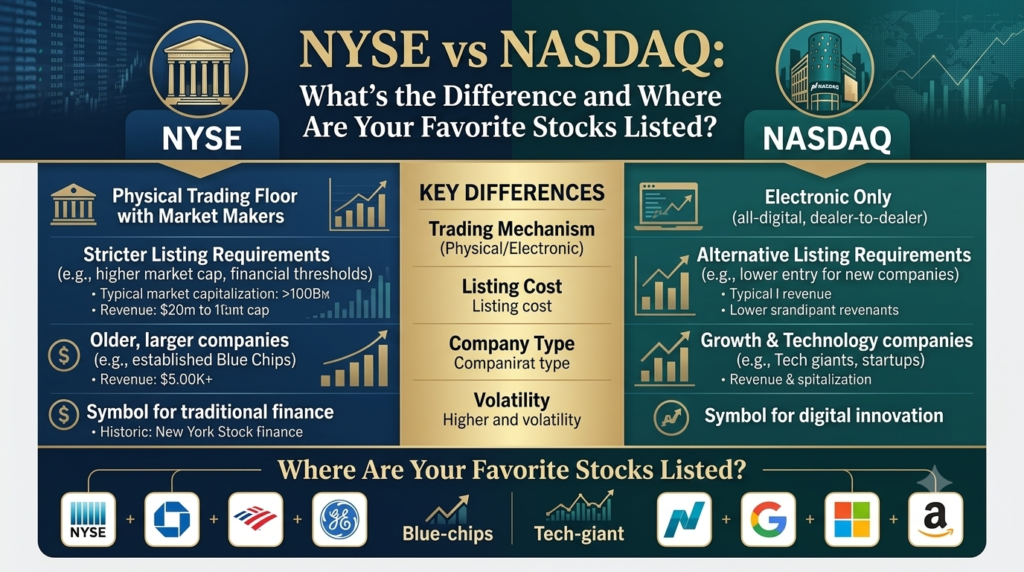
The most noticeable NYSE vs NASDAQ difference lies in their trading models. The New York Stock Exchange uses a hybrid system that combines electronic trading with designated market makers who help facilitate transactions and maintain fair pricing during periods of high market activity. NASDAQ, on the other hand, is a completely electronic exchange that relies on a network of competing market makers to match buyers and sellers almost instantly. This electronic-first approach has made NASDAQ one of the fastest trading platforms in the world, while the NYSE continues to blend modern technology with human oversight to enhance market stability.
Trading Method
When people think about Wall Street, they often picture traders standing on a busy trading floor shouting orders. While that image still exists to some extent at the NYSE, today’s trading environment is far more advanced. Most trades on the NYSE are executed electronically, but designated market makers continue to play an important role by ensuring liquidity and helping prevent extreme price swings during volatile market conditions. Their presence provides an additional layer of stability, especially when markets experience sudden news or unexpected economic events.
NASDAQ takes a completely different approach. There is no physical trading floor where buyers and sellers gather. Instead, every transaction takes place through sophisticated computer systems that connect brokers, institutions, and investors around the world within milliseconds. Multiple market makers compete to provide the best available prices, which often leads to tighter bid-ask spreads and extremely efficient trade execution. This technology-driven structure has helped NASDAQ become the preferred exchange for many fast-growing companies that value speed, innovation, and scalability.
Market Structure
Another important aspect of the NYSE vs NASDAQ difference is how each exchange organizes its market. The NYSE operates as an auction market, where buyers and sellers compete directly to determine the best available price for a stock. Orders are matched based on supply and demand, while designated market makers step in whenever necessary to maintain orderly trading. This structure has been trusted for more than two centuries and continues to support many of the world’s largest corporations.
NASDAQ functions as a dealer market rather than an auction market. Instead of matching buyers and sellers directly, numerous market makers hold inventories of stocks and continuously quote buying and selling prices. Investors trade with these market makers rather than with one another directly. This competitive system encourages liquidity, supports rapid order execution, and contributes to the exchange’s reputation for efficiency. While both systems ultimately accomplish the same objective, their underlying mechanics represent one of the biggest operational differences between the two exchanges.
Listing Requirements
Every company that wants to become publicly traded must satisfy specific listing requirements before joining an exchange. Both the NYSE and NASDAQ enforce strict financial, governance, and reporting standards designed to protect investors and ensure market integrity. These standards include minimum shareholder equity, market capitalization, public float, corporate governance policies, and ongoing financial disclosures. Companies that fail to maintain these requirements risk being delisted.
Although both exchanges maintain high standards, there are differences in their eligibility criteria and listing options. The NYSE generally attracts larger, well-established corporations with substantial operating histories and strong financial performance. NASDAQ offers several market tiers that allow growing businesses and innovative companies to access public capital while still meeting rigorous regulatory requirements. As a result, investors often associate the NYSE with stability and mature businesses, while NASDAQ is frequently viewed as the home of innovation and high-growth enterprises.
Companies Listed on NYSE
The New York Stock Exchange is known for hosting many of the world’s most recognizable blue-chip companies. These organizations typically have decades of operating history, diversified revenue streams, and strong reputations within their industries. Many of them pay consistent dividends, generate reliable cash flow, and maintain leadership positions in sectors such as finance, healthcare, industrial manufacturing, consumer goods, and energy. For investors seeking long-term stability, the NYSE offers a broad selection of established businesses that have demonstrated resilience across multiple economic cycles.
Some of the most recognized companies trading on the NYSE include:
- The Coca-Cola Company
- Walmart
- JPMorgan Chase
- Visa
- The Walt Disney Company
- McDonald’s
- ExxonMobil
- Johnson & Johnson
- Boeing
- IBM
These companies represent industries that have shaped the global economy for decades. Their size, financial strength, and international presence often make them attractive choices for conservative investors who prioritize steady growth and income over rapid expansion. While no investment is entirely risk-free, many NYSE-listed companies have built reputations for weathering economic downturns and delivering long-term shareholder value.
Popular Companies Listed on NASDAQ
NASDAQ has earned its reputation as the exchange of innovation, attracting businesses that are transforming technology, artificial intelligence, cloud computing, biotechnology, digital commerce, and semiconductor manufacturing. Many of today’s fastest-growing companies chose NASDAQ because of its electronic infrastructure, strong technology focus, and global investor base. These businesses often prioritize rapid expansion, research and development, and disruptive business models over traditional corporate structures.
Some of the best-known NASDAQ-listed companies include:
- Apple
- Microsoft
- NVIDIA
- Amazon
- Alphabet (Google)
- Meta Platforms
- Tesla
- Netflix
- Adobe
- Intel
These companies have played a major role in reshaping industries and influencing everyday life across the globe. Although many NASDAQ stocks have delivered exceptional long-term returns, they also tend to experience higher price volatility due to rapid innovation, changing consumer trends, and evolving competitive landscapes. For investors with a higher tolerance for risk, NASDAQ offers exposure to some of the world’s most dynamic businesses.
Key Differences Investors Should Know
Choosing between companies listed on the NYSE and NASDAQ isn’t about deciding which exchange is “better.” Instead, it’s about understanding how each exchange aligns with different types of businesses and investment strategies. While both exchanges are highly regulated and offer investors access to thousands of publicly traded companies, their characteristics can influence stock behavior, liquidity, and long-term growth potential. Recognizing these distinctions can help you build a diversified portfolio that matches your financial goals.
When evaluating stocks, investors should focus on company fundamentals rather than assuming an exchange automatically guarantees better returns. A strong company on NASDAQ can outperform a weak company on the NYSE, and vice versa. Still, knowing the environment in which a company operates provides valuable context. The NYSE vs NASDAQ difference often reflects the type of businesses you’ll find, their growth stage, and how they respond to changing market conditions.
Market Performance
Both the NYSE and NASDAQ have produced outstanding investment opportunities over the years, but their performance patterns often differ because of the industries they represent. The NYSE includes many mature companies in sectors such as banking, healthcare, industrial manufacturing, consumer goods, and energy. These businesses generally generate stable revenue and consistent profits, making them attractive during periods of economic uncertainty. Investors seeking dependable dividend income and relatively lower volatility often gravitate toward NYSE-listed stocks.
NASDAQ, by contrast, is heavily weighted toward technology and innovation. As a result, its performance is frequently driven by advances in artificial intelligence, cloud computing, semiconductor technology, software, and digital services. During periods of rapid technological growth, NASDAQ has historically outperformed many traditional market segments. However, when interest rates rise or investor sentiment shifts away from growth stocks, NASDAQ can also experience sharper declines. This higher growth potential often comes with increased volatility, making careful research even more important.
Technology vs Traditional Businesses
One of the easiest ways to understand the distinction between these exchanges is to look at the types of companies they attract. The NYSE has long been home to established corporations with decades of operating history. These businesses often have diversified revenue sources, global operations, and proven management teams. Their primary focus is usually sustainable profitability, operational efficiency, and delivering steady returns to shareholders over the long term.
NASDAQ has become synonymous with innovation. Many companies listed there are leaders in artificial intelligence, biotechnology, software development, electric vehicles, cybersecurity, and digital communications. These organizations invest heavily in research and development, aiming to create products and services that reshape entire industries. While this creates exciting opportunities for investors, it also introduces additional risks because growth expectations are often built into stock prices. A single disappointing earnings report or slower-than-expected product launch can lead to significant price swings.
Volatility Comparison
Volatility refers to how much a stock’s price moves over time, and it plays an important role in investment decisions. Generally speaking, many NASDAQ-listed companies experience greater price fluctuations because they operate in fast-changing industries where innovation drives competition. New technologies, changing regulations, product announcements, and economic conditions can all influence share prices within a short period. For investors comfortable with higher risk, these fluctuations may present opportunities to buy quality companies during market pullbacks.
NYSE-listed companies, on the other hand, often demonstrate more stable price movements because many of them operate in mature industries with predictable cash flows. Their businesses may not grow as rapidly as emerging technology firms, but they often provide greater resilience during economic slowdowns. This stability can be especially attractive for retirees, income-focused investors, or anyone seeking to reduce overall portfolio risk. That said, even blue-chip stocks can experience periods of volatility during major market events, which is why diversification remains essential regardless of where a company is listed.
Which Exchange Is Better for Investors?
The answer depends entirely on your investment objectives, time horizon, and tolerance for risk. Neither exchange consistently outperforms the other because they serve different segments of the market. Instead of choosing between the NYSE and NASDAQ, experienced investors often own companies from both exchanges to create a balanced portfolio. Combining stable blue-chip businesses with innovative growth companies can help reduce risk while maintaining long-term growth potential.
If your goal is steady wealth accumulation through dividend-paying companies and established businesses, you’ll likely find many attractive opportunities on the NYSE. If you’re focused on long-term capital appreciation and believe in the future of technology, healthcare innovation, and digital transformation, NASDAQ offers access to many of the world’s fastest-growing companies. A thoughtful investment strategy doesn’t rely solely on the exchange—it prioritizes strong financial fundamentals, competitive advantages, and long-term business quality.
Long-Term Investing
Long-term investors benefit from patience, consistency, and disciplined decision-making rather than trying to predict short-term market movements. Both exchanges include companies that have rewarded shareholders over decades through capital appreciation, dividend growth, and business expansion. Investors who regularly contribute to diversified portfolios often experience the benefits of compounding, regardless of whether their holdings trade on the NYSE or NASDAQ.
Successful long-term investing also involves looking beyond daily headlines. Market corrections, economic cycles, and temporary volatility are normal parts of investing. Companies with durable competitive advantages, strong balance sheets, and effective leadership are often better positioned to navigate these challenges. Instead of chasing the latest trend, focusing on business quality can produce more reliable results over time.
Growth Investing
Growth investing emphasizes companies expected to increase revenue and earnings at above-average rates. NASDAQ is widely recognized for hosting many of these businesses, particularly in technology, biotechnology, artificial intelligence, and digital services. Investors attracted to high-growth opportunities often accept greater short-term volatility in exchange for the possibility of substantial long-term returns.
However, growth investing requires careful analysis. Rapidly expanding companies can face intense competition, changing consumer preferences, regulatory challenges, and evolving technologies. Investors should evaluate factors such as revenue growth, profitability, market leadership, and management quality before making investment decisions. While high-growth stocks can deliver impressive gains, maintaining diversification and avoiding excessive concentration in a single sector remains a prudent strategy.
How to Check Where a Stock Is Listed
Whether you’re a beginner or an experienced investor, knowing where a stock is listed is an important part of researching a company. Fortunately, finding this information is quick and straightforward. Most financial websites, brokerage platforms, and company investor relations pages clearly indicate whether a stock trades on the New York Stock Exchange (NYSE) or NASDAQ. The exchange is usually displayed alongside the stock ticker symbol, making it easy for investors to identify where shares are bought and sold.
Checking a company’s listing can also provide useful context about its history, industry focus, and market presence. While the exchange itself should never be the only factor in an investment decision, understanding where a stock is traded helps you better interpret news, earnings reports, and market trends. If you’re comparing companies within the same industry, knowing their exchange can also highlight differences in size, maturity, and growth potential.
Here are a few simple ways to check where a stock is listed:
- Search the company’s ticker symbol on your brokerage platform.
- Visit the company’s Investor Relations page.
- Use reputable financial news websites.
- Check the official NYSE or NASDAQ company directory.
- Search the company name on trusted market data platforms.
Taking just a few minutes to verify this information can strengthen your investment research and help you better understand the market environment in which a company operates.
Common Myths About NYSE and NASDAQ
Despite their popularity, there are several misconceptions surrounding these two stock exchanges. Many new investors assume that one exchange is always better than the other, but that’s far from the truth. Both exchanges operate under strict regulatory oversight and provide access to some of the world’s largest and most successful companies. The real difference lies in the types of businesses they attract and the trading systems they use—not in the overall quality of the investments available.
Another common myth is that NASDAQ only lists technology companies. While technology giants dominate the exchange, thousands of businesses from healthcare, biotechnology, consumer services, finance, retail, and communications are also listed there. Likewise, although the NYSE is known for established corporations, it also welcomes companies from innovative industries that meet its listing standards. Understanding these realities helps investors avoid making assumptions based solely on an exchange’s reputation.
Some of the biggest myths include:
- Myth: NYSE stocks are always safer than NASDAQ stocks.
- Reality: Investment risk depends on the individual company, not the exchange.
- Myth: NASDAQ only lists technology companies.
- Reality: It includes businesses from many different sectors.
- Myth: Companies listed on the NYSE never experience volatility.
- Reality: Every publicly traded company can be affected by market conditions.
- Myth: Exchange selection determines investment returns.
- Reality: Company fundamentals, earnings growth, valuation, and management quality have a much greater impact on long-term performance.
Recognizing these misconceptions allows investors to focus on meaningful research rather than outdated assumptions.
Final Verdict: Understanding the NYSE vs NASDAQ Difference
Choosing between companies listed on the NYSE and NASDAQ isn’t about picking a winner—it’s about understanding how each exchange supports different kinds of businesses. The NYSE vs NASDAQ difference primarily comes down to trading structure, company profiles, market focus, and historical identity. The NYSE is often associated with established, dividend-paying, blue-chip corporations, while NASDAQ has become the preferred home for many innovative, high-growth companies that are shaping the future of technology and business.
For investors, the smartest approach is rarely choosing one exchange over the other. Instead, building a diversified portfolio that includes quality companies from both markets can provide a healthy balance between stability and growth. Whether you’re investing for retirement, generating passive income, or pursuing long-term capital appreciation, understanding the NYSE vs NASDAQ difference gives you greater confidence when evaluating stocks and making informed investment decisions. Ultimately, successful investing depends far more on selecting strong businesses than on the exchange where their shares happen to trade.
Conclusion
The U.S. stock market offers investors access to two of the world’s most influential exchanges, each serving a unique role in global finance. The New York Stock Exchange has built its reputation on stability, tradition, and housing many of the world’s largest established corporations. NASDAQ, meanwhile, has become the symbol of innovation, technological advancement, and high-growth businesses that continue to reshape industries around the globe. Both exchanges contribute significantly to market efficiency, investor confidence, and economic growth.
Understanding the NYSE vs NASDAQ difference enables investors to look beyond ticker symbols and gain a deeper appreciation of how financial markets operate. Rather than viewing one exchange as superior, it’s more productive to evaluate each company on its financial strength, competitive position, growth prospects, and long-term potential. Investors who combine thorough research with diversification and patience are generally better positioned to navigate changing market conditions and pursue lasting financial success.
Frequently Asked Questions (FAQs)
1. What is the biggest NYSE vs NASDAQ difference?
The biggest difference is that the NYSE operates using a hybrid auction system with designated market makers, while NASDAQ is a fully electronic dealer market with multiple competing market makers.
2. Is NASDAQ better than the NYSE for investing?
Neither exchange is inherently better. NASDAQ is known for growth-oriented companies, while the NYSE is recognized for many established blue-chip businesses. The better investment depends on the individual company and your financial goals.
3. Can the same company be listed on both NYSE and NASDAQ?
No. A company’s common stock is generally listed on only one primary U.S. exchange at a time, although it may also trade internationally through other markets or depository receipt programs.
4. Why do technology companies prefer NASDAQ?
NASDAQ’s electronic trading infrastructure, innovation-focused reputation, and strong investor interest in growth companies have made it a popular choice for technology and biotech businesses.
5. Should beginners care about where a stock is listed?
Yes. While the exchange alone shouldn’t determine your investment decisions, understanding where a company is listed provides useful insight into its market environment, industry characteristics, and trading structure.